
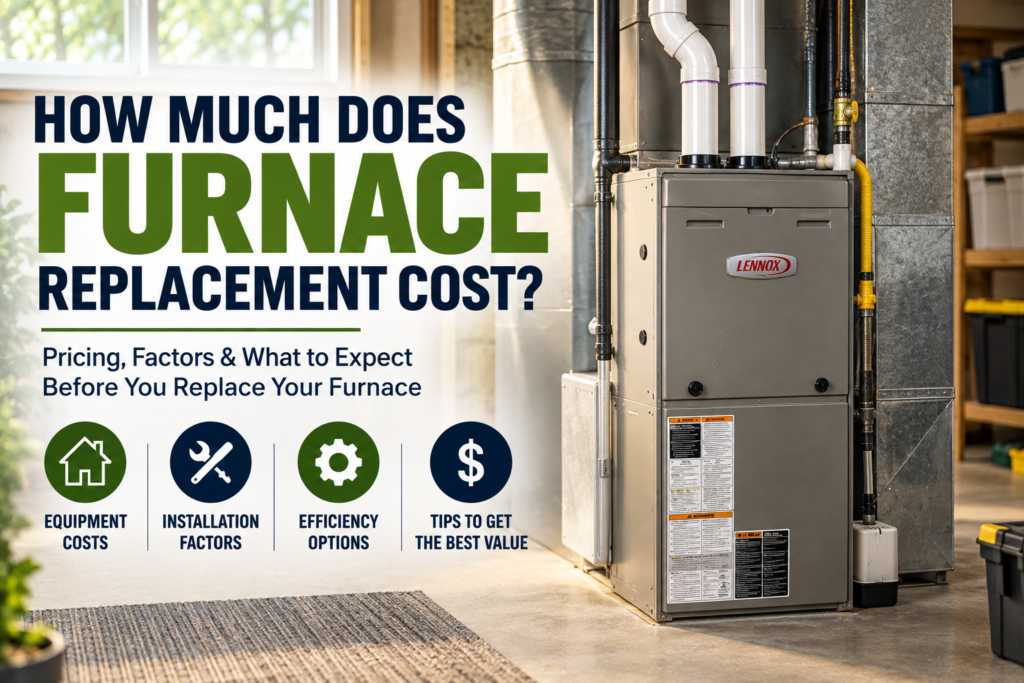
Replacing a furnace can be a straightforward equipment swap or a larger heating-system project. The difference usually comes down to the furnace itself, the condition of the existing installation, and how much work has to happen around the new equipment.
Pricing Disclaimer: The prices and cost ranges in this article are provided for general informational and budgeting purposes only. They are based on national industry data and third-party sources and do not represent quotes, guarantees, advertised prices, or binding estimates from Brown Road Heating & Cooling. Actual HVAC costs can vary based on equipment type, system size, efficiency, installation requirements, labor, materials, permits, electrical or ductwork needs, property conditions, product availability, and other project-specific factors. Pricing may also change over time. Contact us for an inspection and written estimate based on your home and the work being proposed. Any written estimate or agreement provided directly by Brown Road Heating & Cooling will control over pricing information shown in this article.
For planning purposes, a furnace replacement commonly costs about $2,800 to $7,500 installed. Larger furnaces, higher-efficiency equipment, difficult access, new venting, duct changes, or fuel and electrical work can push the total higher.
We do not price a replacement from the furnace model alone. We also look at what the new equipment needs in order to work properly in the home.
What You’re Paying for When a Furnace Is Replaced
The furnace is only one part of the replacement project.
A complete installation may involve:
- New furnace equipment
- Removal of the old furnace
- Disposal
- Installation labor
- Gas or electrical connections
- Venting
- Condensate drainage
- Sheet-metal transitions
- Thermostat work
- Blower setup
- Startup and testing
- Safety checks
- Permit and inspection requirements
That is why an online furnace price and a contractor’s installed quote can look completely different.
One may be the price of the equipment sitting in a warehouse.
The other may cover everything required to remove the old system, install the new one, connect it to the home, and confirm that it is operating correctly.
Before comparing two prices, we look at what each proposal includes.
Furnace Replacement Cost by Fuel Type
The type of furnace can have a large effect on replacement cost.
Natural gas furnace
Gas furnaces are common in homes with an existing natural gas supply.
The price can depend on:
- Furnace capacity
- AFUE rating
- Existing gas connection
- Venting
- Condensate drainage
- Electrical requirements
- Installation access
A basic gas-furnace replacement using compatible existing infrastructure can be fairly reasonable.
A high-efficiency replacement that needs new venting and drainage can involve more work, driving up the cost.
Electric furnace
Electric furnaces tend to have simpler combustion-related requirements because there is no gas burner or combustion vent.
That does not mean every electric-furnace project is inexpensive.
We still have to look at:
- Electrical service
- Circuit requirements
- Heating capacity
- Blower setup
- Ductwork
- Controls
An older home may need electrical work before new equipment can be installed.
Propane furnace
Propane furnaces operate similarly to gas furnaces in many respects, but the fuel setup and equipment configuration may differ.
We may need to consider:
- Existing propane supply
- Gas piping
- Venting
- Furnace configuration
- Equipment availability
Oil furnace
Oil furnaces can involve a different set of installation requirements.
Fuel storage, venting, equipment selection, and the existing system all affect the job.
If you are considering changing from one heating fuel to another, the project can become much more involved than replacing like-for-like equipment.
Why AFUE Changes the Price of a Furnace
AFUE stands for Annual Fuel Utilization Efficiency.
It describes how efficiently a furnace converts fuel into usable heat over a heating season.
A higher AFUE rating generally means the furnace wastes less of the fuel’s energy.
That can affect the initial price.
Higher-efficiency gas furnaces may also need installation changes that an older standard-efficiency furnace did not require.
Depending on the equipment, that may involve:
- Different venting
- Intake piping
- Condensate drainage
- New controls
- Different furnace components
So the price increase is not always limited to the furnace itself.
We would not automatically recommend the highest AFUE furnace available.
We would look at the home’s heating needs, current setup, budget, fuel costs, and how long you expect to keep the equipment.
Furnace Size Can Move the Quote Too
Furnaces are commonly rated in BTUs.
That number describes heating capacity.
A larger furnace generally costs more than a smaller model in the same product line.
The more important question is whether the capacity fits the home.
We do not want to replace an 80,000-BTU furnace with another 80,000-BTU furnace simply because that is what was installed years ago.
The old furnace may have been:
- Oversized
- Undersized
- Selected before insulation improvements
- Installed before an addition was built
- Chosen using an old rule of thumb
Heating load depends on several parts of the house:
- Square footage
- Insulation
- Air leakage
- Windows
- Ceiling height
- Exterior exposure
- Local winter conditions
- Ductwork
- Home additions
A load calculation can help determine what the building actually needs.
We would rather size the furnace for the home as it exists now.
A Straight Furnace Swap Costs Less Than a Conversion
Some replacements are much simpler than others.
Straight replacement
Imagine a gas furnace being replaced with another compatible gas furnace.
The existing:
- Gas connection works
- Venting is suitable
- Electrical setup is usable
- Duct connections need little change
- Furnace location is accessible
That can be a relatively straightforward project.
More involved replacement
Now imagine replacing older equipment with a higher-efficiency furnace that needs different venting and a condensate drain.
Or converting from electric heat to gas.
The project may now involve:
- New venting
- Gas-line work
- Electrical changes
- Drainage
- Sheet-metal changes
- Permit requirements
The farther the new system moves from the old setup, the more installation work may be involved.
That is one reason we need to see the existing system before giving you an accurate replacement quote.
High-Efficiency Furnaces May Need Different Venting
A high-efficiency condensing gas furnace can vent differently from older equipment.
Older furnaces may use a metal flue.
Many high-efficiency systems use different vent materials and may require both exhaust and combustion-air piping.
They can also produce condensate.
That means a replacement may need:
- New vent routing
- Wall or roof penetrations
- Intake piping
- Condensate drain
- Drain routing
- Neutralization equipment in some applications
The exact requirements depend on the furnace and installation.
We do not recommend assuming that an existing vent can always be reused.
Labor Cost Depends on More Than Hours
Furnace installation labor covers more than carrying one furnace out and setting another one in its place.
The work may include:
- Disconnecting old equipment
- Removing it from the property
- Positioning the new furnace
- Building sheet-metal transitions
- Connecting gas or electrical service
- Installing venting
- Connecting drainage
- Wiring controls
- Setting blower operation
- Starting the furnace
- Testing heating operation
- Completing safety checks
- Cleaning the work area
Access also matters.
A furnace in an open basement or utility room can be easier to work around than equipment installed in:
- A tight crawlspace
- An attic
- A small closet
- A difficult mechanical room
The equipment may be similar while the labor involved is quite different.
Ductwork Can Change a Furnace Replacement Price
A new furnace still has to move air through the existing duct system.
We look at that ductwork before assuming it should stay exactly as it is.
Possible issues include:
- Restricted return air
- Leaky ducts
- Damaged flex duct
- Poor supply transitions
- Undersized ducts
- Weak airflow
- Missing insulation
The furnace blower needs to move enough air through the system.
If the ducts are restricting that airflow, installing new equipment without addressing the cause can leave you with the same comfort problems.
We do not assume every furnace replacement needs new ductwork.
We want to know whether the existing ducts can support the equipment being installed.
If airflow or duct problems are part of the project, check out our broader HVAC services for more information about the systems we work on.
What Could Be Added to the Furnace Quote?
A furnace proposal may include optional or property-specific work.
That can include:
- New thermostat
- Humidifier
- Filtration equipment
- Gas-line changes
- Electrical work
- Venting
- Condensate drainage
- Duct modifications
- Permit
- Equipment removal
- Code corrections
Some of those items may already be included.
Others may appear separately.
Ask what the quote covers before comparing it with another proposal.
A price that looks higher may simply include more of the work the project needs.
Why Two Furnace Replacement Quotes Can Be Thousands Apart
Consider three hypothetical projects.
Quote A: Like-for-like gas furnace replacement
The existing furnace is replaced with a similar standard-efficiency model.
The project uses:
- Existing gas connection
- Existing compatible vent
- Existing thermostat
- Existing duct system
Very little has to change around the furnace.
This is a relatively simple installation.
Quote B: Higher-efficiency gas furnace
The homeowner chooses a higher-AFUE furnace.
The new system needs:
- Different venting
- Condensate drain
- Thermostat adjustments
- Sheet-metal changes
The price is higher because the project includes more than a different furnace cabinet.
Quote C: Larger installation correction
The old furnace has airflow problems.
The new proposal includes:
- New furnace
- Return-air correction
- Duct transition work
- Electrical changes
- New thermostat
- Difficult equipment removal
That quote could be thousands of dollars higher than Quote A and still be completely reasonable.
The two contractors are not pricing the same job.
What We Check Before Recommending a New Furnace
We do not start with replacement simply because a furnace has a problem.
We look at the equipment first.
That may include:
- Furnace age
- Current failure
- Repair history
- Heat exchanger condition
- Blower operation
- Controls
- Venting
- Ductwork
- Airflow
- Fuel connection
- Furnace capacity
- Heating performance
We also look at what has changed in the house.
Maybe insulation was added.
Maybe an addition was built.
Maybe a basement was finished.
Maybe the current furnace has always heated unevenly.
Those details can change what we recommend.
You can see more about the heating work we provide on our furnace repair, installation, and replacement page.
Repair or Replace the Furnace?
A furnace does not need to be replaced every time something fails.
A repair can still make sense when:
- The problem is isolated
- The furnace is otherwise in good condition
- The repair history is limited
- Parts are available
- The system heats the home properly
- Repair cost is reasonable
Replacement deserves more consideration when several issues begin stacking up.
That may include:
- Older equipment
- Repeated repairs
- Major component failure
- Heating problems
- Parts availability
- Safety concerns
- Poor overall condition
We look at the whole furnace rather than using one age number to make the decision.
If your system is having trouble now, check out our furnace services for repair and replacement information.
Should You Replace the Furnace and AC Together?
Sometimes it makes sense to discuss both systems.
It is not always necessary.
A furnace and central AC often share indoor equipment.
The furnace blower may circulate cooled air during summer.
The indoor AC coil may sit directly above or beside the furnace.
We may talk about replacing both when:
- The furnace and AC are similar ages
- Both are nearing replacement
- Major HVAC work is already planned
- Equipment compatibility is a concern
- The indoor coil also needs replacement
Keeping one system may make more sense when it is still relatively new and works well.
We would rather look at both pieces of equipment than use a blanket rule.
If the cooling side is also part of your decision, read our guide to central air repair and replacement costs.
Questions to Ask Before Accepting a Furnace Replacement Quote
Before you approve a replacement, make sure you understand the proposal.
Ask:
- What exact furnace model is included?
- What fuel does it use?
- What is the BTU input and output?
- What is the AFUE rating?
- Why was this furnace size selected?
- Is old-equipment removal included?
- Is disposal included?
- Are permit costs included?
- Does the venting need to change?
- Is the thermostat included?
- Is ductwork included?
- Is gas-line work included?
- Is electrical work included?
- Is condensate drainage included?
- What manufacturer warranty applies?
- What labor warranty applies?
- What could change the final price after work begins?
Those answers make quote comparisons much easier.
Furnace Replacement Cost Questions Homeowners Ask Us
How much is a furnace replacement?
A furnace replacement commonly costs about $2,800 to $7,500 installed in current national pricing data. Larger furnaces, high-efficiency equipment, venting changes, ductwork, difficult access, or fuel and electrical work can increase the total.
How much does a furnace replacement cost?
The cost depends on the furnace type, heating capacity, AFUE rating, labor, venting, existing ductwork, removal, and other installation requirements. An equipment-only furnace price should not be compared directly with a complete installed quote.
How much does furnace replacement cost for a gas furnace?
Gas-furnace pricing varies based on furnace capacity, AFUE rating, venting, gas connections, labor, and installation conditions. Higher-efficiency condensing furnaces may cost more because they can require different venting and condensate drainage.
Is an electric furnace cheaper to replace?
Electric furnaces can have lower upfront equipment and installation costs in some situations because they do not need combustion venting. Electrical capacity, equipment size, ductwork, and labor still affect the final price.
Does furnace replacement include labor?
A full installed quote usually includes labor, but you should confirm. Equipment-only prices generally do not cover removal, installation, connections, testing, and other project work.
Does the furnace price include removal of the old unit?
Not always. Ask whether removal and disposal are included in the proposal.
Does a higher-efficiency furnace cost more?
Usually. Higher-AFUE equipment can cost more, and some installations also require new venting, drainage, or controls.
What size furnace do I need?
Furnace size should be based on the heating load of the house. Square footage matters, but so do insulation, windows, air leakage, ceiling height, ducts, and local winter conditions.
Should I repair or replace my old furnace?
We look at the current failure, furnace age, repair history, overall condition, safety, parts availability, and replacement cost. A contained repair may make sense when the rest of the furnace is still in good condition.
Do you replace furnaces?
Yes. We provide furnace installation, replacement, repair, and maintenance in Hendersonville and nearby Western North Carolina communities.
Need a Furnace Replacement Estimate?
If you’re comparing furnace replacement prices, we can look at more than the equipment model.
We evaluate the existing furnace, heating needs, venting, airflow, ductwork, fuel connection, and installation conditions before recommending new equipment.
Check out our furnace services or call us at (828) 338-6261 to schedule an estimate.
Comments are closed