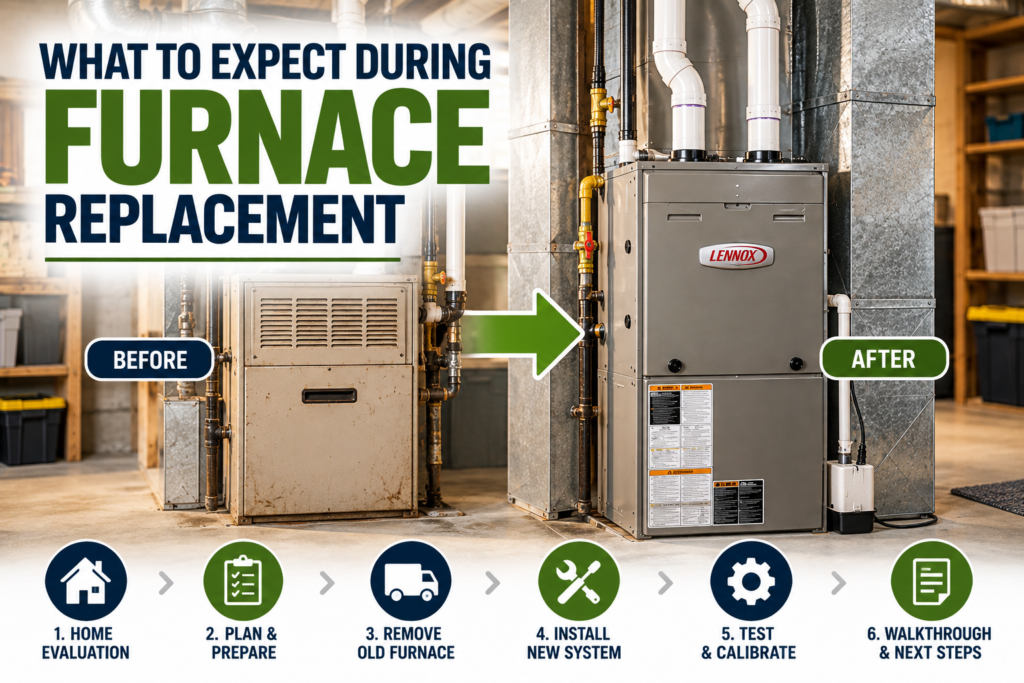
A furnace replacement usually starts before installation day. We first need to understand the existing system, the home’s heating needs, the ductwork, the venting, the fuel or electrical connections, and any other heating and hvac problems problems you have been dealing with.
On installation day, the old furnace is disconnected and removed. We prepare the area for the new equipment, make any required connection changes, install the new furnace, configure the controls, start the system, test its operation, and review the new setup with you before we leave.
A straightforward replacement should move through those steps fairly quickly. A project that needs new venting, duct changes, electrical work, or other corrections can take longer.
Furnace Replacement Timeline at a Glance
| Stage | What generally happens |
| Before installation | We evaluate the current furnace and the home |
| Equipment selection | Furnace size, efficiency, and configuration are confirmed |
| Home preparation | The work area and access path are cleared |
| Old furnace removal | Existing equipment is safely disconnected and removed |
| Site preparation | Duct, vent, drain, gas, or electrical changes are made if needed |
| New furnace installation | The replacement furnace is set and connected |
| Startup | Controls and equipment settings are configured |
| Testing | Heating, airflow, and safety operation are checked |
| Walkthrough | We review the thermostat, filter, and basic care with you |
The Replacement Process Starts Before Installation Day
We do not want to arrive with a new furnace and assume everything that was used with the old one should stay exactly the same in the setup of the new unit.
Before replacement, we may look at:
- Existing furnace type
- Heating capacity
- Equipment age
- Repair history
- Comfort complaints
- Ductwork
- Return airflow
- Venting
- Gas connection
- Electrical connection
- Thermostat
- Equipment access
- Changes made to the house over the years
One of the questions we want to answer is whether the old furnace was actually a good fit for the home.
A furnace may have been oversized from the day it was installed. An addition may have changed the heating load. New windows or insulation may have changed what the house needs and the efficiency of heating the home.
We would rather evaluate the home as it is now than repeat an old equipment choice without checking it.
If you are still deciding whether replacement is the right step, our furnace installation and replacement services page explains the heating work we provide.
You Should Know What Is Being Installed Before the Crew Arrives
You should have a clear idea of what the replacement includes before installation day.
That means knowing details such as:
- Furnace model
- Fuel type
- Heating capacity
- Efficiency rating
- Thermostat changes
- Venting changes
- Duct modifications
- Removal and disposal
- Warranty
- Any work excluded from the proposal
A furnace replacement quote can cover a simple equipment changeout or a larger project involving changes around the supporting furnace infrastructure.
Those are different jobs.
If you want more detail about the financial side of replacement, read our guide to furnace replacement costs.
For installation day, the more useful question is whether everyone understands the agreed scope before work begins.
How to Prepare Your Home for Furnace Replacement Day
You usually do not need to do much before we arrive, but a little preparation can make access easier.
Clear the furnace area
Move boxes, storage containers, laundry, and other items away from the equipment.
We need room to remove the old furnace and bring in the new one.
Clear the path to the equipment
The crew may need to move a large furnace through:
- Hallways
- Basement stairs
- Garage
- Utility room
- Crawlspace access
- Attic access
Keeping that route open helps prevent unnecessary delays.
Secure pets
The crew may be moving equipment in and out of the house, which can mean exterior doors open periodically.
Keeping pets in a separate area can make the job easier for everyone.
Make mechanical areas accessible
If the furnace is in an attic, crawlspace, basement, or locked utility room, make sure we can get to it.
Ask about heat downtime
The furnace will be unavailable for part of the installation.
If cold weather is expected, ask what that means for your specific project. (making arrangements for the family to stay with relatives, etc.)
What Happens to the Old Furnace?
The first major installation step is removing the existing equipment.
Depending on the system, that can involve:
- Shutting off electrical power
- Closing and disconnecting the fuel supply where applicable
- Disconnecting thermostat and control wiring
- Separating venting
- Disconnecting duct transitions
- Removing drainage connections
- Moving the old furnace out of the house
The old furnace may have been connected to the home for many years.
Once it is removed, parts of the installation that were difficult to see before may become easier to inspect.
That can include:
- Duct transitions
- Old wiring
- Vent connections
- Drainage
- Equipment platform
- Corrosion
- Prior installation work
That is one reason replacement is more involved than simply sliding one cabinet out and putting another in the same spot.
The New Furnace May Not Connect Exactly Like the Old One
New furnaces can have different dimensions and connection requirements from older equipment.
That can affect:
- Supply plenum
- Return-air connection
- Venting
- Gas piping
- Electrical connections
- Condensate drain
- Filter setup
- Thermostat wiring
A higher-efficiency gas furnace may also need a different venting arrangement from the system it replaces.
The new cabinet may be shorter, taller, narrower, or positioned differently.
We may need to build or modify sheet-metal transitions so the furnace connects properly to the duct system.
The goal is not to make the new furnace fit the old opening at any cost.
We want the new equipment to fit the heating system correctly.
Ductwork and Airflow Get Checked Before Everything Is Closed Up
A furnace depends on airflow.
It can produce heat correctly and still perform poorly if the duct system cannot move that air through the house.
During replacement, we may look at:
- Supply connection
- Return-air connection
- Plenum
- Filter rack
- Blower configuration
- Existing duct restrictions
- Airflow complaints from the old system
If an existing return is too restrictive, simply connecting a new furnace to it does not make the restriction disappear.
The same applies to damaged or poorly configured ductwork.
We want to know the furnace can move the air the home needs before we consider the installation complete.
If the project uncovers broader airflow or duct issues, you can learn more about the systems we work on through our HVAC services.
Gas, Electrical, Venting, and Drainage Are Connected Next
Once the furnace is set in place, the supporting connections have to be completed.
The exact work depends on the furnace.
Gas furnace
A gas furnace may involve:
- Gas connection
- Shutoff
- Electrical power
- Venting
- Combustion-air piping
- Condensate drainage on condensing models
Electric furnace
An electric furnace may involve:
- Electrical circuit
- Controls
- Heating elements
- Blower connections
- Thermostat wiring
We keep this work on the professional side of the project.
Gas, high-voltage electrical connections, venting, and combustion equipment are not areas where we recommend homeowner trial and error.
Your Thermostat May Need Attention Too
The thermostat is part of the heating system.
Depending on the new furnace, your existing thermostat may be:
- Reused
- Rewired
- Reconfigured
- Replaced
Compatibility can depend on:
- Furnace stages
- Blower setup
- Heat-pump pairing
- Control requirements
- Whether the system uses communicating equipment
A new furnace may also operate differently from the old one.
For example, a staged furnace may not behave the same way as a basic single-stage system.
Before we leave, you should know how to:
- Change the temperature
- Change operating mode
- Use any schedules
- Recognize basic thermostat messages
There is little value in installing new heating equipment if the homeowner does not understand how to control it.
Turning the Furnace On Is Only the Start of Testing
We do not consider a furnace replacement complete because the equipment produced heat once.
The startup process is where we confirm that the system is operating the way it should.
Depending on the furnace, we may check:
- Thermostat response
- Ignition sequence
- Heating cycle
- Blower operation
- Airflow
- Supply and return temperatures
- Safety controls
- Venting
- Gas operation where applicable
- Condensate drainage
- Shutdown sequence
- Error codes
The exact testing depends on the equipment.
A gas furnace has combustion-related checks that an electric furnace does not.
A staged furnace may need control verification that a simpler system does not.
The point is the same.
The system should be tested as a complete heating setup rather than treated as finished once the cabinet is connected.
What the Final Walkthrough Should Cover
Before the job wraps up, we want you to know how to live with the new furnace.
That usually means going over:
- Thermostat operation
- Filter location
- Filter size or type
- Filter access
- Basic filter care
- Normal furnace operation
- Maintenance recommendations
- Warranty paperwork
- Who to contact with questions
This is also a good time to ask anything that was not clear during the installation.
You may want to know:
- Why the furnace runs longer than the old one
- Why airflow feels different
- Where the filter is located
- What a thermostat message means
- When the equipment should be maintained
For the last question, our guide on how often furnace maintenance is needed covers the normal service schedule.
How Long Should You Expect Furnace Replacement to Take?
A straightforward furnace replacement may be completed in several hours or within one working day.
We would not promise one fixed timeline without seeing the installation.
Several things can extend the project:
- New venting
- Duct modifications
- Difficult equipment access
- Electrical work
- Gas-line changes
- Fuel conversion
- Additional HVAC equipment
- Conditions uncovered after the old furnace comes out
A furnace in an open utility room with compatible existing connections is a different project from one installed in a cramped attic that needs new duct and vent work.
Ask about the expected schedule for your specific installation rather than relying on a universal number.
How Much Disruption Should You Expect?
Furnace replacement is active work inside the house.
For part of the project:
- Heating will be unavailable
- Tools will be in the mechanical area
- Equipment will move in and out
- Exterior doors may open periodically
- You may hear drilling, cutting, or equipment movement
- Gas or electrical service to the furnace may be shut off temporarily
The work should still be organized.
The furnace area should be cleaned up when the project is done, and old equipment should be removed if that is part of the agreed installation.
You usually do not need to leave the home for a routine replacement unless the specific project creates a reason to do so.
What Could Change After the Old Furnace Comes Out?
Some conditions are easier to see after the existing equipment is removed.
We may uncover:
- Damaged duct transition
- Rust
- Corrosion
- Drainage problem
- Electrical issue
- Venting problem
- Clearance issue
- Previous installation shortcut
That does not mean unexpected work should simply happen without discussion.
If we find something that changes the agreed scope, we should explain:
- What we found
- Why it matters
- What work is being recommended
- Whether it changes the project
You should have a chance to understand additional work before it moves forward.
That communication matters as much as the mechanical work itself.
Your New Furnace May Feel Different From the Old One
New heating equipment does not always behave exactly like the furnace it replaces.
You may notice:
- Different airflow
- Different cycle length
- Quieter blower operation
- Different thermostat response
- Staged heating
- More gradual temperature changes
A longer heating cycle does not automatically mean something is wrong.
A staged or variable-speed system may deliberately operate differently from older equipment.
We recommend asking what normal operation should look and sound like before the installation crew leaves.
That gives you a baseline.
What to Watch During the First Few Days
Pay attention to how the new system behaves during normal use.
Look for:
- Thermostat reaching the set temperature
- Consistent heating
- Normal starts and stops
- Airflow from registers
- Unexpected noise
- Water where it should not be
- Error messages
- Persistent odors
The first heating cycle can sometimes create a temporary smell as dust or manufacturing residue warms up.
A persistent burning smell, electrical odor, or fuel odor deserves attention.
The same goes for repeated shutdowns or a furnace that cannot reach the thermostat setting.
When to Call Back After Furnace Installation
Contact the installer if you notice something that does not seem right.
Examples include:
- Furnace does not reach set temperature
- Repeated error code
- New loud noise
- Persistent fuel odor
- Persistent electrical odor
- Water leakage
- Weak airflow
- Repeated shutdown
- Thermostat does not control the equipment correctly
You do not need to diagnose the issue yourself.
Describe what you are seeing or hearing.
If you need service after installation, our furnace repair and service page explains the heating work we provide.
What We Want Homeowners to Know Before Replacement Day
A furnace replacement is easier to follow when you know what should happen.
Before the project begins, we would want you to know:
- What furnace is being installed
- What work is included
- Whether the thermostat is changing
- Whether ductwork or venting will change
- How long the furnace is expected to be off
- How the old equipment will be removed
- What testing will be done
- Where the filter will be
- What maintenance the new system needs
- What warranty applies
You should not have to guess what is happening in your own home.
Furnace Replacement Questions Homeowners Ask Us
What should I expect during furnace replacement?
Expect the existing system to be evaluated first. On installation day, the old furnace is disconnected and removed, the new furnace is positioned and connected, controls are configured, the system is started and tested, and the installer should review operation and basic care with you before leaving.
How long does furnace replacement take?
A straightforward replacement may take several hours to one day. Projects involving new venting, duct modifications, difficult access, gas or electrical work, or other changes can take longer.
Will I be without heat during the installation?
Yes. The furnace will be unavailable while the old equipment is disconnected and the new system is installed and tested.
Do I need to leave the house?
Usually not for a routine replacement. The crew needs access to the furnace area and a clear route for moving equipment.
Do I need to move things before the installer arrives?
Clear stored items away from the furnace and open the path between the equipment and the entry door. Secure pets and make sure attic, basement, crawlspace, or utility-room access is available.
Does the old furnace get removed?
In a standard furnace replacement, the existing furnace is typically disconnected, removed, and disposed of as part of the project if that work is included in the proposal.
Will my ductwork need to change?
Sometimes. New furnace dimensions, airflow requirements, existing duct conditions, or old transitions may require modifications.
Will I need a new thermostat?
Not always. The answer depends on whether your current thermostat is compatible with the new furnace and its controls.
What gets tested after furnace installation?
The installer should verify heating operation, thermostat response, airflow, blower operation, applicable safety controls, and other equipment-specific functions before the system is handed back to you.
What should I ask the installer before they leave?
Ask how to use the thermostat, where the filter is located, what filter it uses, what normal operation should look like, how often maintenance is recommended, and what warranty coverage applies.
Can you replace my furnace?
Yes. We provide furnace installation and replacement in Hendersonville and nearby Western North Carolina communities.
Planning a Furnace Replacement?
If you are preparing for a furnace replacement, we can walk you through the project before installation day so you know what equipment is being installed, what work is included, and what to expect when the old furnace comes out.
Check out our furnace installation and replacement services or call us at (828) 338-6261 to schedule an evaluation.
Comments are closed