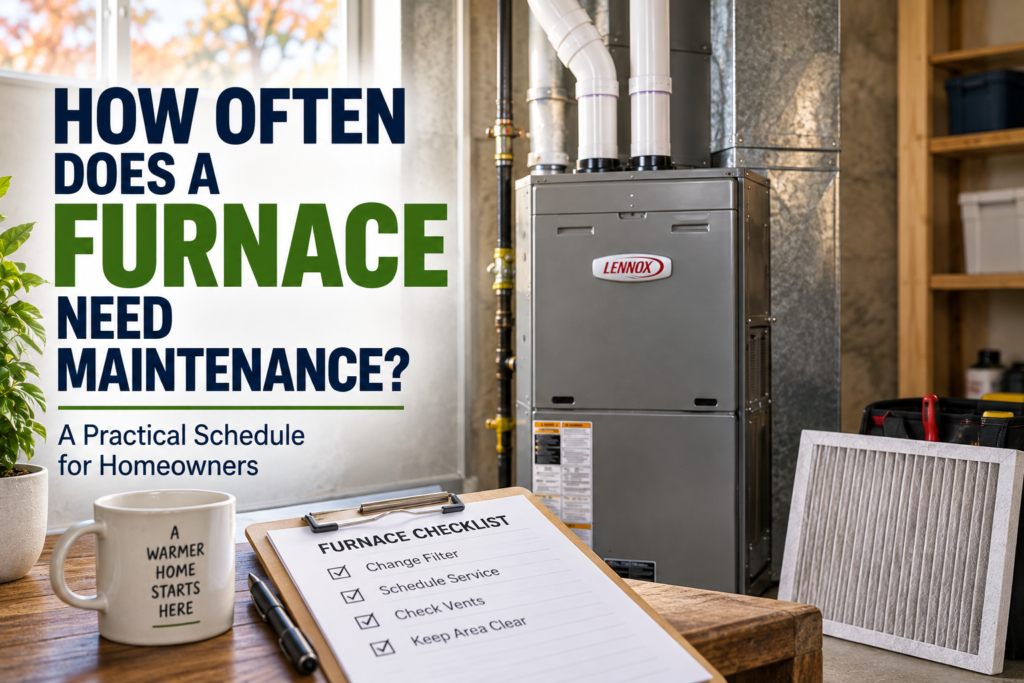
For most homes, we recommend professional furnace maintenance once a year, ideally before the heating season begins. Early fall is usually a good time because the furnace has not yet entered its busiest stretch of the year.
That annual visit is only one part of furnace care.
Filters may need attention more often. Airflow can change between service appointments. A new noise, odor, ignition problem, or heating issue should be checked when it appears rather than waiting for the next scheduled tune-up.
The schedule that makes the most sense is:
annual professional maintenance + regular homeowner checks + service whenever the furnace starts behaving differently.
Furnace Maintenance Schedule at a Glance
| Furnace task | General timing |
| Professional furnace maintenance | Once per year |
| Best time for professional service | Before heating season |
| Check furnace filter | Regularly according to filter and manufacturer guidance |
| Replace or clean filter | As needed for filter type and household conditions |
| Check supply vents and returns | Periodically |
| Watch for new noise, odor, or heating changes | Anytime |
| Schedule repair service | As soon as a problem develops |
Annual maintenance gives us a chance to inspect the furnace while it is still operating normally.
The rest of the year, we want homeowners to pay attention to their system for signs of new issues.
Why Early Fall Is Usually the Best Time for Furnace Service
We generally prefer to check furnaces before cold weather arrives.
There are a few practical reasons for that.
The furnace has not yet been running hard every day.
If we find a worn part or another issue, there is usually more time to deal with it before you depend on the system full-time.
Heating contractors also tend to get busier once colder weather settles in.
From a homeowner’s point of view, testing the furnace early is easier than discovering a problem on the first cold night of the season.
We would rather find a weak component in September than after the furnace stops heating the house in January.
That does not mean fall is the only time maintenance can be done.
If the furnace missed its annual service, scheduling it later is still more useful than skipping it altogether.
Annual Maintenance and Filter Changes Are Not the Same Thing
Changing or cleaning the filter is one of the most useful things you can do between service visits.
It is not the same as professional furnace maintenance.
Filter maintenance
The filter catches dust and debris before that material can move farther into the HVAC system.
How often it needs attention depends on:
- Filter thickness
- Filter type
- Pets
- Household dust
- Remodeling
- How often the HVAC system runs
- Manufacturer guidance
Many common furnace filters need attention somewhere around every one to three months, but we do not treat that as a universal schedule.
A thicker media filter may last longer.
A home with pets, dust, or construction activity may need more frequent checks.
Professional furnace maintenance
A professional visit looks beyond the filter.
Depending on the furnace and the service being performed, we may inspect:
- Heating operation
- Blower performance
- Electrical connections
- Ignition components
- Burners
- Heat exchanger condition
- Venting
- Safety controls
- Thermostat operation
Changing the filter helps the system breathe.
It does not replace checking the furnace itself.
What We Look at During a Furnace Maintenance Visit
The exact maintenance procedure depends on the furnace.
Gas furnaces and electric furnaces do not have identical components, and different models can have different service requirements.
Depending on the system, we may check:
- Thermostat operation
- Filter condition
- Blower operation
- Electrical connections
- Ignition sequence
- Burner operation
- Gas controls where applicable
- Heat exchanger condition
- Venting
- Condensate drainage on condensing furnaces
- Supply and return temperatures
- Safety controls
- Startup
- Shutdown
- Unusual noise
- Unusual vibration
We are looking for changes that may not be obvious during normal day-to-day use.
A furnace can still heat the house while a component is starting to weaken.
Maintenance gives us a chance to catch visible or measurable problems before they become larger.
For more information about the heating work we provide, check out our furnace maintenance and repair services.
When a Furnace May Need Attention Before the Annual Visit
The annual schedule does not stop new issues from arising.
If the furnace starts behaving differently, we want to know about it when the change happens.
Schedule service sooner if you notice:
- Furnace will not maintain the thermostat setting
- New rattling, grinding, or other noise
- Burning or electrical odor
- Weak airflow
- Frequent cycling
- Furnace blows cool air
- Rooms heat unevenly
- Utility use changes sharply without an obvious reason
- Repeated ignition problems
- Visible soot or unusual discoloration
- Carbon monoxide alarm activates
Some of those symptoms can have simple causes.
Others can point to equipment or safety issues that should be inspected.
A tune-up six months ago does not mean the furnace cannot develop a new problem today.
If you are seeing a change in operation, visit our furnace repair and service page.
An Older Furnace May Deserve Closer Monitoring
Older equipment does not automatically need professional maintenance several times per year.
Annual service is still a common baseline.
What changes with age is how much attention we pay to new symptoms.
An older furnace may deserve a closer look if you notice:
- Longer heating cycles
- More frequent repairs
- New ignition trouble
- Blower changes
- Uneven temperatures
- More noise
- Venting issues
- Declining heating performance
A 15-year-old furnace that has been heating normally may still be worth maintaining.
A much younger furnace with repeated failures may need more investigation.
We look at condition and repair history along with age.
If you are starting to think about replacement, our guide to furnace replacement costs can help with budgeting and quote comparison.
Heavy Furnace Use Can Change How Often You Check Things
Some furnaces work harder than others.
A home with a long heating season or poor insulation may rack up more operating hours.
The same can happen when the property has:
- High dust levels
- Pets
- Recent construction
- Frequent door opening
- Air leaks
- Heavy daily occupancy
That does not automatically mean the furnace needs a full professional tune-up every few months.
It does mean filters and visible conditions may need more frequent attention.
For example, a home with several pets may load a filter faster than a low-dust home with no pets.
If airflow starts dropping between annual service visits, check the filter before assuming the furnace itself has failed.
Gas and Electric Furnaces Still Need Regular Maintenance
Gas and electric furnaces do not have the same internal parts.
Both still need regular attention.
Gas furnace
A gas furnace may include:
- Burners
- Ignition system
- Gas valve
- Heat exchanger
- Venting
- Blower
- Controls
Professional maintenance can include checks related to combustion and safe operation.
Electric furnace
An electric furnace does not use gas burners or a combustion vent.
It still depends on:
- Heating elements
- Electrical controls
- Blower
- Wiring
- Airflow
- Thermostat operation
The maintenance procedures differ.
The annual-service idea still applies to both.
If you are not sure what type of heating system you have, our furnace services page explains the heating equipment we work on.
Furnace Maintenance Becomes a Safety Question in Some Situations
For gas and other combustion furnaces, maintenance can include looking at components tied to safe operation.
That may include:
- Heat exchanger
- Burner operation
- Venting
- Gas connections
- Safety controls
Carbon monoxide alarms should never be treated like normal maintenance reminders.
If a carbon monoxide alarm activates, follow the alarm manufacturer’s instructions and appropriate emergency guidance.
The same applies if you smell gas or another fuel odor.
Those situations should be handled as immediate safety concerns rather than something to put on the annual maintenance calendar.
What Homeowners Can Check Between Professional Visits
There are several safe things you can watch between service appointments.
Check the filter
Look at it regularly and replace or clean it according to its instructions.
Keep supply registers open
Closing too many registers can change airflow through the system.
Keep return grilles clear
Furniture, rugs, boxes, and other items should not block return airflow.
Keep the furnace area clear
Do not stack household items against the furnace.
Check thermostat settings
Make sure the thermostat is in the intended mode and temperature setting.
Listen for changes
A furnace that suddenly sounds different is worth paying attention to.
Watch how the house heats
If certain rooms suddenly become colder or the furnace struggles to reach the thermostat setting, something may have changed.
Keep carbon monoxide detectors working
For homes with combustion equipment, working carbon monoxide alarms are an added layer of safety.
We have a separate guide covering what to check before calling for HVAC service if you want a simple troubleshooting list.
What We Would Not Recommend Doing Yourself
Basic filter and thermostat checks are different from opening up a furnace and working on internal components.
We would not recommend homeowners:
- Adjust gas valves
- Disassemble burners
- Bypass safety switches
- Repair ignition components
- Open electrical compartments
- Attempt heat exchanger repairs
- Make internal wiring changes
Those jobs can involve fuel, electricity, combustion, or safety controls.
If the furnace problem goes beyond a filter, thermostat setting, or visible airflow issue, it is usually time to have the system inspected.
Does Annual Furnace Maintenance Prevent Every Breakdown?
No.
A furnace can be maintained and still have a part fail later.
Mechanical and electrical components wear over time.
What maintenance can do is give us a chance to find problems that are visible or measurable while the system is operating.
That may include:
- Worn components
- Dirty parts
- Loose electrical connections
- Restricted airflow
- Venting issues
- Changes in ignition
- Blower problems
We see maintenance as a chance to find developing problems while the furnace is still working.
It is not a promise that nothing can break later.
Does Furnace Maintenance Affect Warranty Coverage?
Warranty requirements vary by manufacturer and model.
Some equipment warranties may require the owner to maintain the system or keep records showing that service was performed.
Do not assume one rule applies to every furnace.
Check the written warranty for your specific equipment.
If you have the furnace model number, the manufacturer can usually provide the warranty terms that apply to that system.
Keeping service records is a good habit either way.
Is Furnace Maintenance Needed After a Major Repair?
Sometimes a technician may recommend follow-up service after a major repair.
The timing depends on what was repaired.
Examples of larger furnace work can involve:
- Blower
- Controls
- Ignition system
- Gas components
- Major electrical components
A repair appointment and annual maintenance visit are not always interchangeable.
If significant work has been done, ask the technician when the furnace should be checked again.
When Furnace Maintenance Turns Into a Repair Conversation
A maintenance visit can uncover a problem.
That does not mean the maintenance itself failed.
It means the inspection found something that may need separate work.
Examples can include:
- Failing electrical part
- Ignition problem
- Blower issue
- Venting concern
- Damaged component
- Safety issue
Maintenance and repair are different services.
The maintenance visit may identify the problem.
The repair addresses it.
If you want more detail about how those service types differ, read our guide to HVAC repair and service costs.
The Furnace Maintenance Schedule We Recommend Homeowners Remember
You do not need a complicated calendar.
This is the schedule we would keep in mind:
| When | What to do |
| Before heating season | Schedule professional furnace maintenance |
| During heating season | Check filters according to filter and manufacturer guidance |
| Throughout the year | Keep supply vents and returns unobstructed |
| Any time operation changes | Schedule service instead of waiting |
| After major furnace work | Follow technician or manufacturer recommendations |
| Before relying on furnace after months of inactivity | Test it early |
The annual tune-up is the planned visit.
The rest of the schedule is about paying attention to the system.
Furnace Maintenance Questions Homeowners Ask Us
When is maintenance required on a furnace?
For most homes, professional furnace maintenance once a year is a sensible schedule. We generally recommend doing it before the heating season begins so the system can be checked before it starts running heavily.
How often should furnace maintenance be done?
Once per year is the common professional maintenance schedule. Filter checks and basic homeowner observations happen more often.
What time of year should I service my furnace?
Early fall is usually a good time. It gives you a chance to identify problems before cold weather and before the furnace starts running every day.
Do I need furnace maintenance if it seems to be working fine?
Annual maintenance is still useful when the furnace appears to be working normally. A system can continue producing heat while a component is dirty, worn, or beginning to change.
Is changing the furnace filter enough?
No. Filter care supports airflow, but professional furnace maintenance can involve internal components, heating operation, safety controls, venting, electrical connections, and other parts of the system.
How often should I change the furnace filter?
Follow the filter manufacturer’s instructions. Many common filters need attention roughly every one to three months, though thicker filters, pets, dust, remodeling, and system runtime can change that schedule.
Does an old furnace need maintenance more often?
Annual maintenance may still be the normal schedule. Older equipment deserves closer attention between visits because new noises, airflow changes, repair frequency, or heating problems can become more meaningful with age.
Does a gas furnace need yearly maintenance?
Annual professional service is widely recommended for gas furnaces. Combustion, venting, ignition, blower operation, and safety components are among the areas that may be checked.
Does an electric furnace need annual maintenance?
Regular professional inspection still makes sense. Electric furnaces do not have gas burners, but they still rely on heating elements, electrical controls, blowers, airflow, and thermostats.
Should I wait until fall if my furnace is making noise?
No. A new operating problem should be inspected when it develops. The annual maintenance schedule is for planned care, not a reason to postpone a repair concern.
Can you maintain my furnace?
Yes. We provide furnace maintenance, repair, installation, and replacement in Hendersonville and nearby Western North Carolina communities.
Has Your Furnace Had Its Annual Check?
If your furnace has not been checked since the last heating season, we can inspect it before you have to rely on it every day.
We look at how the system is operating, airflow, controls, heating performance, and other furnace components based on the equipment in your home.
Check out our furnace services or call us at (828) 338-6261 to schedule service.
Comments are closed