
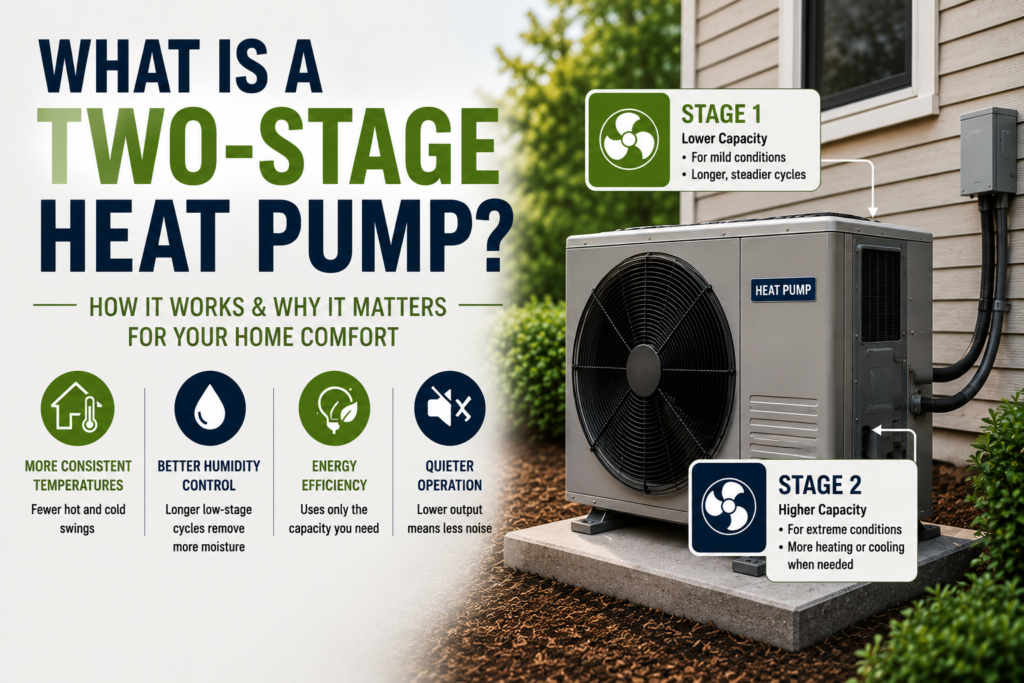
A two-stage heat pump has two levels of compressor output. Most of the time, it can run at a lower capacity when the heating or cooling demand is modest. When the house needs more output, the system can move into its higher stage.
That lets the equipment respond to changing conditions without running at full capacity every time it turns on.
We like to explain it this way: Stage 1 handles the lighter workload. Stage 2 steps in when the home needs more help.
The exact capacity percentages vary by model, but many two-stage systems operate somewhere around 60% to 70% of full output in first stage and 100% in second stage.
Two-Stage Operation at a Glance
| What is happening | Likely system response |
| Mild heating or cooling demand | Stage 1 |
| Small difference from thermostat setting | Usually Stage 1 |
| Hot or cold outdoor conditions | Stage 2 may be needed |
| Large thermostat change | Stage 2 may engage |
| Stage 1 cannot satisfy the thermostat | System moves to Stage 2 |
| Thermostat reaches the set point | System reduces output or shuts off, depending on controls |
The exact sequence depends on the thermostat, control board, equipment design, and operating conditions.
What Actually Changes Between Stage 1 and Stage 2?
The main difference is compressor output.
Stage 1 uses partial capacity
In Stage 1, the compressor operates below its maximum output.
Depending on the model, that may be somewhere around 60% to 70% of full capacity.
That lower output can mean:
- Longer heating or cooling cycles
- Gentler airflow
- Smaller indoor temperature swings
- Less frequent full-capacity operation
The system is still heating or cooling the home.
It is simply doing it at a lower rate.
If the thermostat is only calling for a small amount of heating or cooling, full compressor output may be unnecessary.
Stage 2 uses full capacity
Stage 2 gives the heat pump its higher output.
The system may move into Stage 2 when:
- Outdoor temperatures become more demanding
- Indoor temperature drifts farther from the thermostat setting
- Stage 1 has been running without satisfying the call
- Someone changes the thermostat by several degrees
- The controls determine that more output is needed
At that point, the compressor operates at its higher capacity until the demand drops.
This gives the system two distinct operating levels rather than one fixed output.
How the Heat Pump Decides When More Capacity Is Needed
The thermostat and equipment controls determine when the second stage comes on.
A small difference between the current room temperature and the thermostat setting may only call for Stage 1.
If the temperature gap gets larger, the controls may call for Stage 2.
Another common situation is when Stage 1 has been running for a period of time and the house still has not reached the set point.
The system can respond by increasing output.
The exact logic varies by manufacturer and thermostat.
Some systems depend heavily on thermostat staging.
Others use more of the equipment’s internal controls.
That is one reason we look at both the thermostat and the heat pump when we are diagnosing staging questions.
If you are not even sure whether your home has a heat pump, our guide on how to tell whether you have a heat pump can help you start there.
Longer Cycles Can Be Normal on a Two-Stage System
A homeowner may notice that a two-stage heat pump runs for longer stretches than an older single-stage system.
That can be normal.
A single-stage system often operates more like this:
Full capacity → off → full capacity → off
A two-stage system can spend more time at lower output.
That may look like:
Lower capacity → steady run → higher capacity if needed → off
The point is not to make every cycle as short as possible.
The goal is to match output more closely to what the house needs.
Longer low-stage operation can help the system hold temperature more steadily.
It can also reduce the feeling of large blasts of warm or cool air.
During cooling season, longer operation can give the indoor coil more time to remove moisture from the air.
We would be more concerned if the system:
- Never reaches the thermostat setting
- Runs constantly at high stage
- Loses airflow
- Starts making new noises
- Develops ice
- Shows a sudden change in performance
If you are seeing those symptoms, check out our heat pump repair and service page.
Single-Stage, Two-Stage and Variable-Speed Heat Pumps Work Differently
These terms describe how much control the equipment has over its output.
| Feature | Single-stage | Two-stage | Variable-speed |
| Compressor output levels | One | Two | Many |
| Lower-capacity operation | No | Yes | Yes |
| Full-capacity operation | Yes | Yes | Yes |
| Ability to adjust output | Basic | Moderate | Broad |
| Equipment cost | Usually lower | Usually middle | Usually higher |
| Controls | Simpler | More involved | More advanced |
Single-stage heat pump
A single-stage heat pump has one compressor output.
When it turns on, it operates at full capacity.
When the thermostat is satisfied, it shuts off.
This is the simplest setup.
Two-stage heat pump
A two-stage system can use a lower level or full output.
That gives it more flexibility during mild weather.
Variable-speed heat pump
Variable-speed equipment can adjust across a wider range of capacity.
Instead of choosing between two fixed levels, it may make smaller output changes as conditions change.
We would not say one type is automatically right for every house.
The choice depends on the home, ductwork, comfort goals, budget, and equipment options.
Why Lower Output Can Feel More Comfortable
One of the biggest differences homeowners may notice is how the system feels when it runs.
A two-stage unit does not need to use full capacity during every heating or cooling cycle.
That can create gentler changes in room temperature.
Instead of cooling the house quickly and shutting off, the system may spend more time operating at a lower level.
That can help with:
- More consistent room temperature
- Fewer large swings
- Less noticeable cycling
- More continuous air movement
The rest of the HVAC system still matters.
Poor ductwork can create uneven temperatures even with two-stage equipment.
The same is true for bad airflow, poor insulation, or an incorrectly sized system.
Staging helps the equipment adjust its output.
It cannot correct every problem in the home.
Summer Humidity Is Where Staging Can Become Noticeable
Two-stage cooling can be especially useful when summer humidity becomes part of the comfort problem.
Cooling removes moisture when warm indoor air passes across the cold indoor coil.
The longer the system spends running, the more time that coil has to collect moisture.
A two-stage heat pump may spend longer periods cooling at lower capacity rather than reaching the thermostat setting quickly and shutting off.
That can help with humidity control in the right setup.
The result still depends on:
- Equipment size
- Airflow
- Thermostat settings
- Indoor coil
- Ductwork
- Insulation
- Air leakage
An oversized two-stage system can still have comfort problems.
We want the equipment sized correctly before we start talking about what staging can do.
Two Stages Do Not Mean Heat Pump Plus Backup Heat
This is one of the easiest terms to misunderstand.
A two-stage heat pump refers to two levels of compressor output.
That is different from auxiliary heat.
Two-stage compressor
The heat pump itself has a lower and higher compressor capacity.
Auxiliary heat
Auxiliary heat is a separate source that can help the heat pump when more heating is needed.
In an all-electric setup, that may be electric resistance heat.
Emergency heat
Emergency Heat is a backup operating mode available on some heat-pump systems.
It generally relies on the backup heating source instead of normal heat-pump operation.
Dual-fuel system
A dual-fuel system combines a heat pump with a gas or propane furnace.
A home can therefore have:
- Two-stage heat pump + electric auxiliary heat
- Two-stage heat pump + gas furnace
- Single-stage heat pump + auxiliary heat
- Variable-speed heat pump + backup heat
The word “stage” can mean different things depending on what someone is discussing.
That is why a thermostat showing “Heat Stage 2” does not automatically mean the compressor itself is a two-stage unit.
Does a Two-Stage Heat Pump Use Less Energy?
It can use energy differently because it does not have to run at full compressor output every time there is a call for heating or cooling.
During milder conditions, the system may spend much of its time in the lower stage.
Actual household energy use still depends on:
- Equipment efficiency
- System sizing
- Weather
- Thermostat settings
- Insulation
- Air leakage
- Duct condition
- Installation
- Runtime
A two-stage label by itself does not tell us what your utility bill will be.
A properly installed single-stage system in a well-insulated home can perform differently from a poorly sized two-stage system in a leaky house.
We look at the complete setup.
The Thermostat Has to Understand the Equipment
A two-stage heat pump needs controls that can make proper use of its two operating levels.
Depending on the system, you may see thermostat or wiring references such as:
- Y1
- Y2
- Stage 1
- Stage 2
- Heat 1
- Heat 2
Those labels can vary.
The thermostat needs to be compatible with the heat pump and configured correctly.
The control setup also affects when the system moves between stages.
We do not recommend changing thermostat wiring based on an online diagram.
Two-stage heat pumps can have different control requirements, and some systems use communicating controls that work differently from conventional thermostats.
If the equipment is not staging correctly, we look at the thermostat, wiring, control board, and heat pump together.
When Two-Stage Equipment May Be Worth Considering
A two-stage heat pump may be worth looking at when you want more capacity control than a basic single-stage system provides.
We may discuss it when:
- The home has noticeable temperature swings
- Summer humidity is a recurring concern
- The system operates through broad seasonal conditions
- You want more gradual heating and cooling
- Variable-speed equipment is outside the budget you want to spend
- The current HVAC system is already due for replacement
There are also situations where spending more on staged equipment may not be the first thing we recommend.
For example, the house may have:
- Restricted ducts
- Poor return airflow
- Major insulation problems
- Air leakage
- Equipment sizing issues
We would rather correct those problems before expecting a more advanced compressor to make up for them.
If you are comparing replacement options, our heat pump installation and replacement services page explains the heat-pump work we provide.
Equipment Staging Cannot Fix a Bad HVAC Design
A two-stage heat pump still needs a good system around it.
It will not fix:
- Undersized ducts
- Restricted return air
- Major air leaks
- Poor insulation
- Bad thermostat placement
- Incorrect equipment sizing
- Installation mistakes
Suppose a room barely gets airflow because the supply duct is damaged.
Installing a two-stage heat pump will not repair that duct.
Or suppose the house is uncomfortable because the equipment is too large.
Adding staging may help with part-load operation, but proper sizing still matters.
We want the heating and cooling system to work as one system.
That includes the outdoor unit, indoor equipment, thermostat, blower, ducts, and the house itself.
How We Would Compare Heat Pump Options for Your Home
When we compare single-stage, two-stage, and variable-speed equipment, we look at more than the product label.
We may review:
- Heating load
- Cooling load
- Existing equipment
- Ductwork
- Airflow
- Insulation
- Comfort problems
- Humidity
- Thermostat
- Current utility use
- Equipment efficiency
- Budget
- How long you plan to stay in the home
A two-stage unit can be a good middle ground for some homeowners.
Another home may be well served by single-stage equipment.
Someone else may place more value on the broader capacity control available with variable-speed equipment.
We would rather compare those options against the property than assume the most advanced system is automatically the right one.
You can see the heat-pump repair, installation, replacement, and maintenance work we provide on our heat pump services page.
Two-Stage Heat Pump Questions Homeowners Ask Us
What is a two-stage heat pump?
A two-stage heat pump has two levels of compressor capacity. It can operate at a lower output during lighter heating or cooling demand and move to full output when the home needs more capacity.
What is a 2-stage heat pump?
It is a heat pump with two compressor output levels. Stage 1 handles lower demand. Stage 2 provides higher or full capacity when conditions require more heating or cooling.
How does a 2-stage heat pump work?
The thermostat and system controls decide how much output the home needs. The heat pump starts or runs at lower capacity when demand is modest. If that output is not enough, the system can move to Stage 2.
What percentage does Stage 1 run at?
It depends on the equipment. Many two-stage systems use first-stage capacity somewhere around 60% to 70% of full output. The exact percentage should come from the manufacturer’s specifications for your model.
When does Stage 2 turn on?
Stage 2 may turn on when the temperature is farther from the thermostat setting, when Stage 1 has not satisfied the call, or when outdoor conditions increase the heating or cooling load.
Does a two-stage heat pump run longer?
It can. Two-stage systems may spend longer periods operating at lower capacity. Longer low-stage cycles can be normal when the system is maintaining the thermostat setting.
Is a two-stage heat pump better than single-stage?
It can provide more capacity control, steadier temperatures, and better moisture removal during cooling. A single-stage system may still be a good fit depending on the home, budget, and HVAC design.
Is two-stage the same as variable-speed?
No. A two-stage compressor has two output levels. Variable-speed equipment can adjust through a broader range of capacities.
Is Stage 2 the same as auxiliary heat?
Not necessarily. Stage 2 may refer to the heat pump’s higher compressor output. Auxiliary heat is a separate backup heating source that can help the heat pump when additional heat is needed.
Do I need a special thermostat for a two-stage heat pump?
The system needs a thermostat or control setup that is compatible with staged operation. The exact requirements depend on the heat pump and manufacturer.
Can you install or service a two-stage heat pump?
Yes. We provide heat pump repair, maintenance, installation, and replacement in Hendersonville and nearby Western North Carolina communities.
Comparing Two-Stage Heat Pump Options?
If you are deciding between single-stage, two-stage, and variable-speed heat pumps, we can help you compare the equipment against the house.
We look at heating and cooling needs, ductwork, airflow, humidity, existing controls, and comfort concerns before recommending a system.
Check out our heat pump services or call us at (828) 338-6261 to schedule an evaluation in Hendersonville or a nearby Western North Carolina community.
Comments are closed