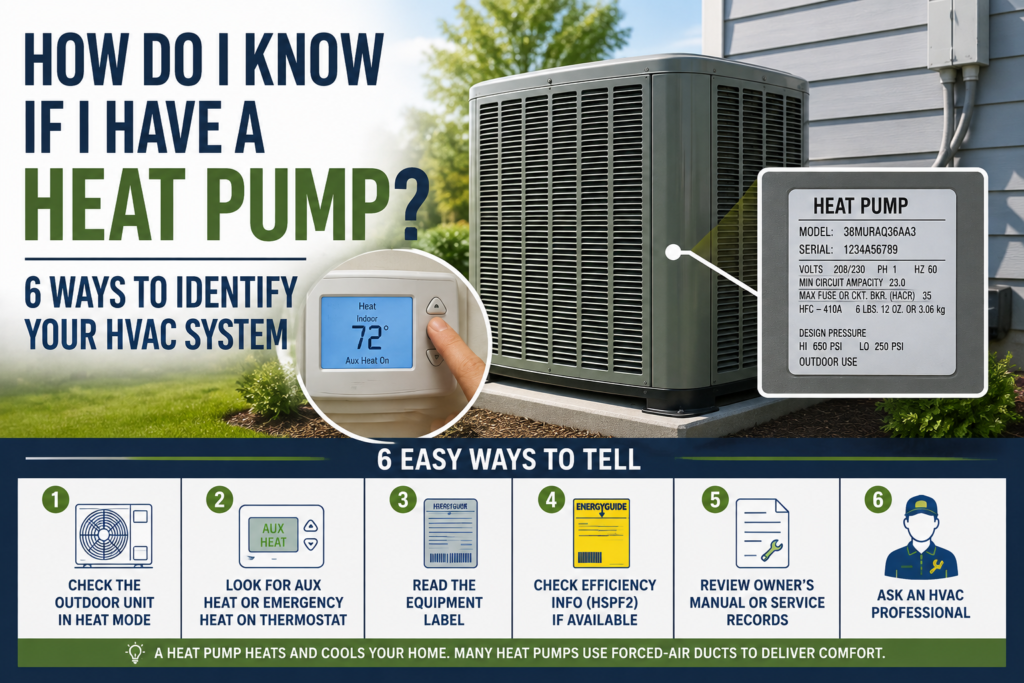
If you are trying to figure out whether your home has a heat pump, start with the thermostat and outdoor unit. Set the thermostat to Heat, raise the temperature a few degrees, and see whether the outdoor HVAC unit starts running. Heat pumps use the outdoor unit during many heating cycles.
You can also look for settings such as Aux Heat or Emergency Heat on the thermostat, check the model number on the equipment label, or look through old service records.
A few home heating systems are less obvious. Some houses use a heat pump together with a gas furnace. Others have a central air conditioner paired with a furnace. Looking at more than one clue gives you a clearer answer.
Heat Pump Identification at a Glance
| What to check | What may point to a heat pump |
| Outdoor unit during heating | Outdoor fan and compressor run during many heating cycles |
| Thermostat | Aux Heat, Auxiliary Heat, Em Heat, or Emergency Heat |
| Equipment label | Says “heat pump” or identifies a heat-pump model |
| Efficiency information | Includes a heating-efficiency rating such as HSPF2 |
| Service records | Mentions heat pump, air handler, or backup heat |
| Indoor equipment | May use an air handler instead of a combustion furnace |
| Manufacturer lookup | Model is listed as a heat pump |
One clue can help. Several matching clues give you a better picture of the system you have.
6 Ways to Tell If You Have a Heat Pump
1. Turn on the heat and check the outdoor unit
This is one of the quickest checks you can do without opening any equipment.
Set the thermostat to Heat. Raise the temperature setting high enough to start a heating cycle. Give it a few minutes, then go outside and look at the outdoor HVAC unit.
If the outdoor fan and compressor are running while warm air is coming from the vents, you likely have a heat pump.
A standard central air conditioner uses the outdoor unit for cooling. A heat pump can use that same outdoor equipment for both cooling and heating.
There is one situation that can make this test less clear. Some homes use a dual-fuel system, which pairs a heat pump with a gas or propane furnace. Under certain conditions, the furnace can handle the heating while the outdoor heat pump remains off.
That is why the outdoor-unit test works best when combined with the other checks below.
Keep your hands outside the cabinet. You do not need to remove panels or touch moving parts to see whether the equipment is operating.
2. Look at the thermostat
Your thermostat can give you another strong clue.
Look for labels or menu options such as:
- Aux Heat
- Auxiliary Heat
- Em Heat
- Emergency Heat
These settings are commonly associated with heat-pump systems that have a backup heat source.
Auxiliary heat can come on automatically when the heat pump needs help meeting the heating demand. The backup source may be electric heat strips or another type of heating equipment, depending on the system.
Emergency heat is a backup operating mode. On many systems, selecting it stops normal heat-pump heating and relies on the backup source.
Thermostats vary, especially smart models. Some hide these settings inside equipment menus. The absence of a visible “Emergency Heat” button does not give you a definitive answer on its own.
3. Read the outdoor equipment label
Find the manufacturer’s label on the outdoor unit.
You may see it on the side or back of the cabinet. You are looking for the brand, model number, serial number, and equipment description.
Some labels state that the unit is a heat pump.
If the label only gives you a model number, write it down or take a photo. Search for that model on the manufacturer’s website or in the product documentation.
This is usually more reliable than trying to decode a model number from a generic online chart. Manufacturers use different naming systems, and those systems can change between product lines.
If the label is faded or damaged, your previous HVAC paperwork may have the same model number.
4. Check the efficiency information
Heat-pump paperwork can include both cooling and heating efficiency information.
You may see:
- SEER2 for cooling efficiency
- HSPF2 for heating-season efficiency
A central air conditioner needs a cooling-efficiency rating. A heat pump also has heating performance to account for.
If your equipment paperwork includes HSPF or HSPF2, that is another useful sign that the outdoor system provides heat.
You may find this information in:
- Manufacturer literature
- Installation paperwork
- Product specifications
- EnergyGuide information
- Online model documentation
There is no need to learn the efficiency calculation just to identify the system. You are looking for evidence that the equipment is rated for both heating and cooling operation.
5. Check old HVAC paperwork
Sometimes the simplest answer is already sitting in a folder, email, or home inspection report.
Look through:
- Installation invoices
- Maintenance records
- Repair invoices
- Warranty registrations
- Home inspection paperwork
- Owner’s manuals
Words such as heat pump, air handler, backup heat, or auxiliary heat may appear in those records.
This can be especially useful if you recently bought the house and do not know what equipment a previous owner installed.
If the paperwork lists a model number, you can also verify it through the manufacturer’s current or archived documentation.
6. Ask an HVAC technician
Some systems are easy to identify from a thermostat or label. Others take a little more digging.
A technician can tell you whether the home has:
- A heat pump
- A central air conditioner
- A gas or propane furnace
- An electric furnace
- An air handler
- A dual-fuel system
- A ductless heat pump
They can also explain how the equipment works together.
That can be useful when a home has been remodeled, equipment has been replaced at different times, or the current thermostat does not clearly identify the system.
Brown Road Heating & Cooling services heat pumps and other residential HVAC equipment in Hendersonville and surrounding Western North Carolina communities.
How Do I Know If I Have a Heat Pump or Forced Air?
The terms “heat pump” and “forced air” can describe the same HVAC system.
Heat pump tells you what type of equipment is producing heating and cooling.
Forced air tells you how conditioned air moves through the house.
A central heat pump often uses an indoor blower to push heated or cooled air through ducts. That makes it a forced-air system.
Here is a simpler way to look at the terms:
| Term | What it tells you |
| Heat pump | The equipment can move heat for heating and cooling |
| Furnace | The equipment produces heat for the home |
| Central AC | The equipment provides cooling |
| Forced air | Air travels through ducts with help from a blower |
| Air handler | Indoor equipment that contains the blower and often a coil |
| Dual fuel | Heat pump paired with a gas or propane furnace |
A home can have a heat pump with forced-air ducts.
Another house might have central AC, a gas furnace, and the same general forced-air duct setup.
A ductless heat pump works differently because the indoor units send conditioned air directly into the rooms they serve.
If your house has floor, wall, or ceiling vents, you probably have some form of forced-air distribution. You still need to identify the heating and cooling equipment connected to those ducts.
How Can I Tell a Heat Pump From a Central Air Conditioner?
An outdoor heat pump and an outdoor central AC unit can look almost identical.
Both usually have:
- A large fan
- A metal cabinet
- Refrigerant lines
- A compressor
- A coil around part of the cabinet
The important difference shows up during heating.
A central air conditioner provides cooling. Heating usually comes from a separate furnace or another heat source.
A heat pump can run the refrigeration system in either direction. It moves heat outside during the cooling season and moves heat inside during the heating season.
| Clue | Heat pump | Central AC |
| Outdoor unit runs during many heating cycles | Yes | No |
| Provides cooling | Yes | Yes |
| Uses refrigeration for heating | Yes | No |
| Has a reversing valve | Yes | No |
| Has a heating-efficiency rating | Yes | No |
You should not rely on appearance alone. The thermostat, model number, operating behavior, and equipment records will tell you more.
How Can I Tell If I Have a Heat Pump or Furnace?
You may have one or both.
A furnace heats the home from indoor equipment. Gas and propane furnaces burn fuel. Electric furnaces use electric heating elements.
A heat pump moves heat through a refrigeration cycle.
Some visual clues can help identify a combustion furnace. You may see a gas line, propane connection, exhaust vent, or furnace cabinet near the indoor HVAC equipment.
A common all-electric heat-pump setup uses an indoor air handler. The air handler contains the blower and the indoor coil. It may also contain electric backup heat.
There is another possibility.
Your home may have a heat pump outside and a gas furnace inside. This type of setup is commonly called a dual-fuel or hybrid heating system.
So finding a furnace indoors does not automatically rule out a heat pump.
What Is a Dual-Fuel Heat Pump System?
A dual-fuel system combines a heat pump with a gas or propane furnace.
During suitable outdoor conditions, the heat pump can provide the home’s heating. When the system decides the furnace should take over, heating switches to the fuel-burning equipment.
That arrangement can confuse homeowners who try the outdoor-unit test once.
You may turn on the heat and see the furnace running while the outdoor unit stays quiet. On another day, the heat pump may run instead.
A dual-fuel home may have:
- A heat-pump outdoor unit
- A furnace indoors
- Forced-air ductwork
- Thermostat controls for both pieces of equipment
The model numbers and thermostat setup usually make this easier to confirm.
What Does a Heat Pump Look Like?
From the outside, many central heat pumps resemble ordinary air-conditioning condensers.
You will usually see a square or rectangular metal cabinet with a fan at the top or side. Refrigerant lines run from the outdoor equipment toward the house.
That appearance indicates the home has split HVAC equipment. It does not indicate whether the unit supports heating.
The easiest visual clues are usually found on the label rather than the shape of the cabinet.
Check for:
- Equipment type
- Manufacturer
- Model number
- Heating-efficiency information
Then compare those details with the manufacturer’s documentation.
A technician may also identify a heat pump by its internal components, including a reversing valve. Homeowners usually do not need to go that far.
Should You Look for the Reversing Valve Yourself?
A reversing valve is a component that allows a heat pump to switch between heating and cooling.
It changes the direction the refrigerant moves through the system.
An HVAC technician can use the presence of that valve to help identify heat-pump equipment.
There is little reason for a homeowner to remove an access panel to find it.
Outdoor HVAC equipment contains moving parts, electrical components, and stored electrical energy. Use the thermostat, equipment label, model information, and service records first.
If those checks still leave you unsure, an HVAC technician can identify the system without turning the process into a do-it-yourself equipment inspection.
Why Does It Matter Whether You Have a Heat Pump?
Knowing what type of HVAC system you have helps you make sense of how the home behaves.
Winter outdoor-unit operation
An outdoor unit running during cold weather can look strange if you think it is only an air conditioner.
For a heat pump, that operation can be normal.
Thermostat settings
Heat-pump thermostats may include auxiliary or emergency heat controls.
Knowing what those settings do can prevent confusion during cold weather.
Service calls
Telling the HVAC company that you have a heat pump gives the technician more information before they arrive.
If you are unsure, the company can still identify the equipment during the visit.
Maintenance
A heat pump may operate through both heating and cooling seasons.
That means the outdoor equipment can achieve more annual runtime than an AC condenser that operates only during warm weather.
Replacement planning
Replacing a heat pump is a different project from replacing a central AC unit paired with a furnace.
Knowing your current setup makes it easier to understand quotes and equipment recommendations.
Quick Heat Pump Identification Checklist
Use this checklist if you want a fast answer:
- Set the thermostat to Heat and see whether the outdoor unit runs.
- Look for Aux Heat or Emergency Heat on the thermostat.
- Check the outdoor equipment label for the words “heat pump.”
- Look up the model number on the manufacturer’s website.
- Check paperwork for HSPF, HSPF2, heat pump, or air handler references.
- Review old HVAC service records.
- Have an HVAC technician identify the system if the clues are unclear.
You do not need to open equipment panels to complete these checks.
Frequently Asked Questions
How do I know if I have a heat pump?
Turn the thermostat to Heat and see whether the outdoor HVAC unit runs during the heating cycle. You can also check the thermostat for Aux Heat or Emergency Heat and look up the model number on the outdoor equipment.
How can I tell if I have a heat pump without checking the outdoor unit?
Look at your thermostat, owner’s manual, installation paperwork, warranty information, or past HVAC invoices. Terms such as heat pump, Aux Heat, Emergency Heat, HSPF2, or air handler can point you in the right direction.
Does Aux Heat mean I have a heat pump?
Auxiliary heat is strongly associated with heat-pump systems. It provides extra heating when the heat pump needs help meeting the thermostat setting. Thermostat setups vary, so use this clue with the equipment label or model information.
Does Emergency Heat mean I have a heat pump?
An Emergency Heat setting is a strong heat pump cue. It allows the system to rely on backup heat rather than normal heat-pump operation. The exact backup source depends on how the HVAC system is configured.
Is a heat pump considered forced air?
Many central heat pumps are forced-air systems. The heat pump provides heating and cooling, while the indoor blower moves conditioned air through ducts. “Heat pump” describes the equipment. “Forced air” describes how air moves through the home.
Can I have a heat pump and a furnace?
Yes. A dual-fuel system pairs a heat pump with a gas or propane furnace. The heat pump may handle heating during some conditions, while the furnace handles heating at other times.
Does a heat pump look different from an AC unit?
Often, no. Central heat pumps and AC condensers can look almost identical from the outside. Checking the operation during heating, thermostat settings, and the model number gives you a better answer.
Does a heat pump run in winter?
Yes. A central heat pump uses its outdoor unit during heating operation. In colder conditions, it may also use backup heat or switch to a furnace in a dual-fuel setup.
Can my model number tell me if I have a heat pump?
Yes. Find the model number on the equipment label and search for it through the manufacturer’s official product information. That is more dependable than assuming a certain letter or number always means “heat pump.”
Can Brown Road tell me what type of HVAC system I have?
Yes. Brown Road Heating & Cooling services heat pumps, furnaces, air handlers, thermostats, and other HVAC equipment in Hendersonville and nearby communities in Western North Carolina.
Still Not Sure What Type of HVAC System You Have?
You do not need to know every part of your heating and cooling system before scheduling service.
Brown Road Heating & Cooling can identify the equipment, explain how the pieces work together, and help you understand whether you have a heat pump, furnace, central AC system, or dual-fuel setup.
Call (828) 338-6261 to schedule HVAC service in Hendersonville or a nearby community.
Comments are closed