
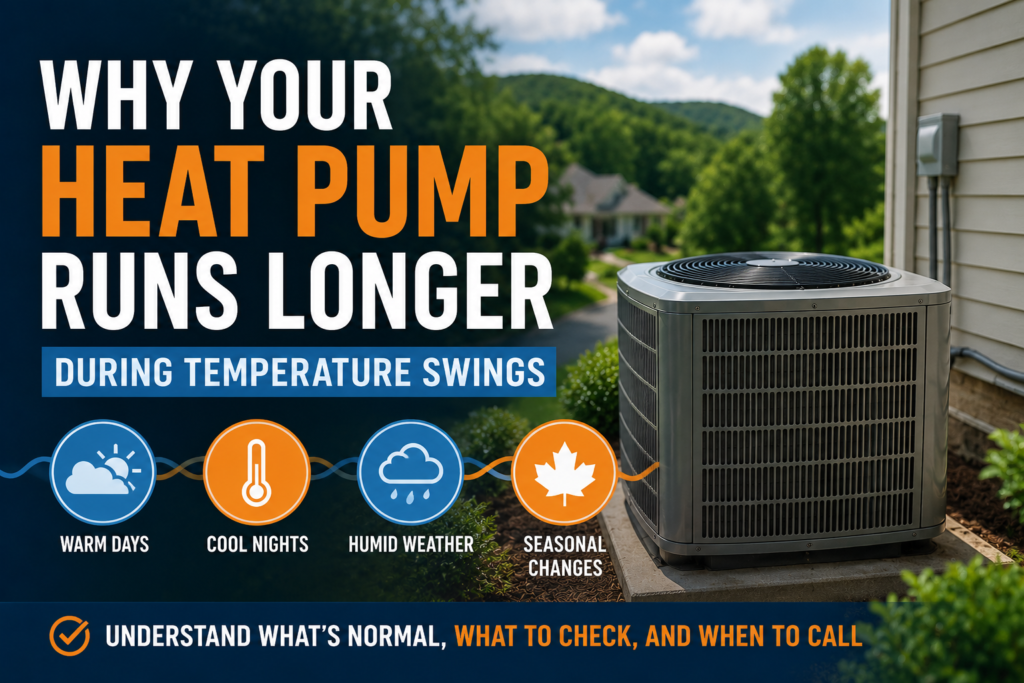
Mills River weather does not always ease from one season into the next. One week may bring warm afternoons, chilly nights, damp mornings, and a sudden return to cooling weather. When that happens, your heat pump may seem to be running more than usual.
That can be normal.
Heat pumps are built to operate differently from furnaces and standard air conditioners. They often run in longer, steadier cycles, especially when outdoor temperatures are changing quickly. The important question is not only how long the system runs. It is whether the property stays comfortable, airflow feels normal, and the equipment runs without unusual sounds, ice, water, odors, or breaker trips.
Here is what Mills River homeowners should know about longer heat pump runtime during temperature swings.
Heat Pumps Do Not Work Like Furnaces
A furnace produces heat and pushes it through the home. A heat pump works differently. It moves heat from one place to another.
In winter, it pulls heat from outdoor air and moves it inside. In summer, it reverses the process and removes heat from the house. Because of that design, a heat pump may run longer than a furnace would during similar conditions.
That does not always mean something is wrong. A heat pump may run steadily to maintain the thermostat setting instead of blasting short bursts of very hot air.
Longer runtime is usually less concerning when:
- The home reaches the thermostat setting
- Rooms feel reasonably even
- Airflow is normal
- The system is not making new sounds
- The breaker is not tripping
- No water or ice is showing up
- Utility use has not changed sharply
The problem starts when the system runs for hours and comfort does not improve.
Temperature Swings Make the System Change Jobs
Spring and fall can be confusing for a heat pump. The system may heat the home in the morning, sit idle through the afternoon, and then cool the house later if indoor temperatures rise.
That back-and-forth can make runtime feel unusual.
A few common shoulder-season patterns include:
- Cool nights followed by sunny afternoons
- Warm days followed by damp, chilly mornings
- Heating one day and cooling the next
- Thermostat schedules that no longer match the weather
- Rooms warming differently because of sun exposure
- Additions, garages, or workshops changing temperature faster than the main home
In Mills River, homes with larger layouts, finished garages, bonus rooms, or separate workspaces can make these differences stand out more. One area may warm quickly in the afternoon while another stays cool. The thermostat may be set to a comfortable temperature in one part of the home while another room still feels uncomfortable.
Long Runtime Can Be Normal When Comfort Holds Steady
A heat pump running longer during a weather shift is not automatically a repair issue.
It may run longer when:
- Outdoor temperatures change quickly
- The system is recovering from a thermostat setback
- The home gained heat during a sunny afternoon
- Humidity makes the air feel heavier
- The system is switching between heating and cooling seasons
- The property has rooms with different exposure or insulation
- The heat pump is maintaining temperature gradually
The key is comfort.
If the thermostat setting is reached, airflow feels steady, and the home feels normal, the system may simply be doing its job. Heat pumps are often designed for steady operation rather than quick temperature swings.
Constant runtime becomes more concerning when the system seems busy, but the house does not get more comfortable.
When Longer Runtime Is a Warning Sign
A long runtime deserves attention when it is accompanied by other symptoms.
Call for service if you notice:
- The heat pump runs for hours without reaching the thermostat setting
- Certain rooms stay too warm or too cold
- Airflow feels weak
- The outdoor unit makes new noises
- The system starts and stops over and over
- Ice forms on the outdoor unit or visible lines
- Water appears near indoor equipment
- The breaker trips
- The thermostat shows auxiliary heat more than usual
- The system blows air that does not match the selected mode
- Energy use rises without a clear reason
One symptom does not always reveal the cause. Weak airflow may be caused by a filter issue, a duct problem, a blower issue, a blocked return, a dirty component, or another condition. Ice may indicate airflow, defrost, control, or performance issues.
That is why a proper diagnosis matters.
Thermostat Settings Can Make Runtime Look Worse
Before assuming the heat pump has a mechanical problem, check the thermostat.
A heat pump may run longer than expected if the thermostat is:
- Set to an aggressive temperature change
- Following an old schedule
- Set to the wrong mode
- Reading a hallway that does not match the rest of the home
- Affected by sunlight, drafts, lamps, or electronics
- Running the fan continuously
- Using smart recovery features the homeowner does not understand
A major setback can also lead to a long recovery time. For example, if the home cools overnight and the thermostat calls for a large jump in the morning, the heat pump may run for a while to catch up.
Simple checks include:
- Confirm heat or cool mode
- Review the programmed schedule
- Check the fan setting
- Replace batteries if needed
- Compare the thermostat reading with another thermometer
- Note whether problem rooms differ from the thermostat location
Avoid making large setting changes just to force the system to catch up. If it cannot maintain a reasonable setting, the issue likely needs attention.
Airflow Problems Often Show Up During Weather Changes
Airflow problems can stay hidden during mild weather. They become easier to notice when the heat pump has to work harder.
Start with the filter. A dirty filter can restrict airflow and cause the system to run longer while delivering less comfort.
Also check:
- Supply vents
- Return grilles
- Furniture blocking registers
- Rugs over floor vents
- Closed interior doors
- Storage boxes near returns
- Rooms at the far end of the duct system
If one room is always the problem, the issue may not be the heat pump alone. It may involve ductwork, insulation, return airflow, sun exposure, or the way the room is used.
Finished garages, workshops, additions, and office spaces can be especially sensitive to airflow problems because they may not behave like the original part of the home.
Outdoor Conditions Matter Too
The outdoor unit plays a major role in the operation of a heat pump. During heating and cooling, it needs open airflow to exchange heat.
Temperature swings often happen during seasons when outdoor debris is also changing. Spring growth, fall leaves, mowing, weeds, grass clippings, and stored yard items can crowd the equipment.
Homeowners can safely:
- Remove loose leaves around the unit
- Trim back grass, weeds, and shrubs
- Move hoses, bins, and tools away
- Keep the top and sides open
- Make sure mulch or debris is not piled against the base
Do not remove panels, reach inside the unit, or try to repair electrical parts. If the outdoor unit hums, rattles, vibrates heavily, freezes, or will not start, schedule service.
Auxiliary Heat May Appear in Certain Conditions
Some heat pump systems use auxiliary heat when they need extra help. This may happen during colder conditions, during a large temperature recovery, or when the system cannot keep up on its own.
Seeing auxiliary heat occasionally is not always a problem. Seeing it often during mild weather is different.
Make a note if:
- Auxiliary heat appears frequently
- It shows up when outdoor temperatures are not especially cold
- The system still does not warm the home
- Utility use climbs noticeably
- The thermostat seems to call for backup heat too often
Do not try to rewire or reprogram equipment to stop auxiliary heat. Write down when it happens and mention it when scheduling service.
Defrost Cycles Can Be Misleading
During damp, cold conditions, frost can form on the outdoor unit. A heat pump may run a defrost cycle to clear it.
During defrost, the system may sound different or seem to operate oddly for a short time. That can be normal.
Heavy ice is different.
Call for service if:
- Ice covers much of the outdoor unit
- Ice returns quickly after clearing
- The heat pump cannot heat properly
- The outdoor fan is not operating normally
- The system makes unusual sounds
- Ice appears along visible lines
Do not chip ice from the unit. That can damage the equipment and does not address the underlying cause.
Humidity Can Make Runtime Feel Worse
Temperature swings are not only about hot and cold air. Humidity can change how comfortable the home feels.
During cooling, the heat pump also helps remove moisture from indoor air. If humidity stays high, the house may feel warm or sticky even when the thermostat looks close to normal.
Humidity concerns may be tied to:
- Weak airflow
- Dirty filters
- Drainage problems
- Dirty indoor components
- Short cycling
- Oversized or poorly matched equipment
- Duct or insulation issues
- Doors opening frequently
If the system runs often but the home still feels damp, lowering the thermostat may not solve the real problem. The heat pump may need maintenance, drainage attention, airflow evaluation, or repair.
What Mills River Homeowners Can Check Before Calling
Before scheduling service, gather a few details.
Check:
- Thermostat mode and schedule
- Fan setting
- Air filter condition
- Supply vents and return grilles
- Outdoor-unit clearance
- Water near indoor equipment
- Ice on visible lines or outdoor equipment
- Whether the outdoor unit runs
- Whether the problem happens in heating, cooling, or both
- Which rooms feel different
- Whether the breaker has tripped
Also, think about timing. Does the problem happen after cold nights? During warm afternoons? When are doors closed? When is humidity high? After a thermostat change?
Those details can help Brown Road Heating & Cooling understand what the system is doing before the visit begins.
Do not handle refrigerant, open electrical compartments, bypass safety switches, keep resetting breakers, or chip ice from the equipment.
When Long Runtime Means It Is Time to Call
Long runtime is worth a service call when the heat pump cannot keep the property comfortable or shows other warning signs.
Call Brown Road when:
- The system runs for hours without reaching the setting
- Rooms stay uneven
- Airflow is weak
- Ice forms or returns
- Water appears near indoor equipment
- Auxiliary heat runs often
- The outdoor unit will not start
- The breaker trips
- New sounds or odors appear
- Energy use rises without a clear reason
If your system runs longer than usual and still cannot keep the property comfortable, Brown Road Heating & Cooling can help with heat pump services in Mills River.
FAQs About Heat Pumps and Temperature Swings
Is it normal for a heat pump to run longer when the weather changes?
Yes. Longer runtime can be normal during temperature swings if the system maintains comfort, airflow feels normal, and there are no warning signs.
Why does my heat pump run more at night?
Cooler nighttime temperatures may increase heating demand, especially after a warm day. The home may lose heat overnight and require longer operation to recover.
Why does my heat pump run during mild weather?
It may be responding to thermostat settings, indoor temperature changes, humidity, room-to-room differences, or recovery from a schedule setback.
Should I worry if auxiliary heat comes on?
Occasional auxiliary heat can be normal in some conditions. Frequent auxiliary heat during mild weather should be checked.
Can a dirty filter make my heat pump run longer?
Yes. A dirty filter restricts airflow, which can make the system work harder to heat or cool the property.
Should I turn off the system if the outdoor unit has ice?
Turn the system off and call for service if ice is heavy, returns often, or the heat pump is not heating properly. Do not chip ice from the unit.
When should I call for heat pump service?
Call when long runtime is accompanied by poor comfort, weak airflow, ice, water, breaker trips, unusual sounds, or failure to reach the thermostat setting.
Get Help With Heat Pump Problems in Mills River
A heat pump that runs longer during temperature swings is not always failing. In many cases, it responds to changing outdoor conditions, thermostat settings, humidity, or how the home gains and loses heat.
The concern is long runtime paired with poor comfort, weak airflow, frequent auxiliary heating or cooling, water or ice buildup, unusual sounds, or rising energy use.
Brown Road Heating & Cooling can inspect the system, explain what is happening, and help determine whether maintenance, repair, or replacement planning makes sense.
Brown Road Heating & Cooling
252 Brown Road
Hendersonville, NC 28791
(828) 338-6261
Comments are closed