
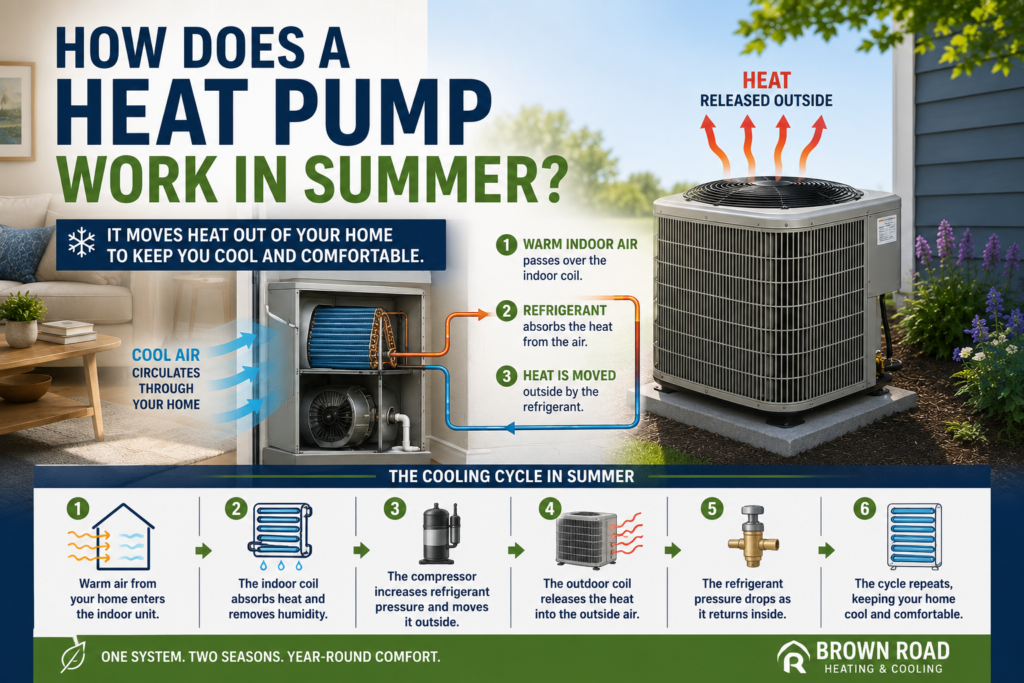
A heat pump cools your home in summer by taking heat from the indoor air and moving it outside. Refrigerant carries that heat between the indoor and outdoor sections of the system while the blower circulates cooler air through the house.
That is why the name can be confusing. A heat pump does not spend the entire year adding heat to your home. Its job is to move heat. During warm weather, it dissipates heat.
For a homeowner, summer operation can feel almost the same as central air conditioning. The difference becomes more obvious once you look at what the equipment can do when winter arrives.
How a Heat Pump Works in Summer at a Glance
| Step | What the system does |
| 1 | Pulls warm household air across the indoor coil |
| 2 | Refrigerant takes on heat from that air |
| 3 | The compressor moves the refrigerant through the system |
| 4 | The outdoor coil releases the collected heat |
| 5 | Refrigerant returns indoors to repeat the process |
| 6 | Moisture removed from indoor air drains away |
The system repeats this cycle until the thermostat no longer calls for cooling.
How Does a Heat Pump Work in Summer?
A summer cooling cycle depends on several HVAC components doing different jobs at the right time.
The homeowner usually notices two things: cool air coming from the vents and an outdoor unit running beside the house. Between those two points, the equipment is constantly moving heat.
1. Warm air from the house reaches the indoor coil
Your thermostat starts the process when the indoor temperature rises above its cooling setting.
The system’s blower begins moving household air through the HVAC system’s return side and across the indoor coil.
During the summer, this coil is cold enough to absorb heat from passing air.
The air leaving the coil has lost some of its heat, so the blower can send cooler air back through the supply ducts.
This is one reason airflow matters so much to air-conditioning performance. If the filter is badly restricted or airflow through the system is limited, the indoor coil may not receive the amount of air the equipment was designed to handle.
2. Refrigerant collects the indoor heat
Inside the coil is refrigerant.
Refrigerant moves through the HVAC system while changing pressure and temperature. Those changes allow it to absorb heat in one location and release it elsewhere.
In cooling mode, the indoor coil is where heat enters the refrigeration cycle.
The system is therefore operating a little differently from how people often describe air conditioning. It is not filling the house with a supply of manufactured cold. It continuously removes heat from indoor air.
The cooler air you feel at a vent is the result.
3. The compressor keeps the refrigeration cycle moving
After the refrigerant absorbs heat indoors, it travels to the outdoor unit.
The compressor is a major part of this stage.
It changes the refrigerant pressure so the system can move heat through the cycle and release it outdoors.
You can think of the compressor as one of the components that keeps the heat-transfer process moving. The exact refrigerant conditions change throughout the circuit, but a homeowner does not need to track those pressure changes to understand what the system is doing.
The important point is that the heat collected inside the house is now being carried toward the outdoor equipment.
4. The outdoor unit gets rid of the heat
Once the refrigerant reaches the outdoor section of the system, the heat has somewhere to go.
The outdoor fan pulls air across the coil while the refrigerant releases the heat it collected indoors.
That heat enters the outdoor air.
If you stand near a heat pump while it is cooling, the air coming from the outdoor unit may feel warmer than the surrounding air.
That is usually exactly what you would expect.
The system has taken heat from the house and is now sending it outside.
5. Refrigerant returns to the indoor side
After giving up heat outdoors, the refrigerant continues through the system and returns to the indoor coil.
Its pressure changes again as part of the refrigeration cycle.
Once it reaches the indoor side, it is ready to collect more heat.
The process continues over and over while the thermostat calls for cooling.
When the home reaches the thermostat setting, the system may shut off or reduce its output, depending on the equipment.
What Does the Reversing Valve Do?
The reversing valve is one of the components that set a heat pump apart from a standard central air conditioner.
During summer, the heat pump moves heat like this:
Inside the house → outside
During heating season, the system can change direction:
Outside → inside the house
The reversing valve helps make that change possible by reversing the direction in which the refrigerant flows through the refrigeration circuit.
You do not normally need to interact with this part. The HVAC system controls the change when you switch between heating and cooling.
This ability to reverse heat flow is why a single outdoor heat pump can handle two seasonal jobs.
During summer, it behaves much like an air conditioner.
During winter, it uses the same general heat-transfer process in reverse.
Does a Heat Pump Work Like an Air Conditioner in Summer?
Yes. For summer cooling, the two systems have a lot in common.
Both use a refrigerant, an indoor coil, an outdoor coil, a compressor, and fans to remove heat from the home.
| Summer operation | Heat pump | Central AC |
| Removes indoor heat | Yes | Yes |
| Uses refrigerant | Yes | Yes |
| Has an indoor cooling coil | Yes | Yes |
| Uses an outdoor compressor | Yes | Yes |
| Releases heat outdoors | Yes | Yes |
| Can reverse the operation to heat the home | Yes | No |
That last point is the main distinction.
A central air conditioner only needs to perform the cooling side of the process. Another heating system, such as a furnace, normally handles winter comfort.
A heat pump can change direction and provide heating as well.
This also explains why the outdoor units can look so similar. You cannot always tell whether a system is a heat pump or conventional AC by looking at the cabinet.
Does a Heat Pump Remove Humidity in Summer?
Yes. Cooling can also remove moisture from indoor air.
Warm household air contains water vapor.
When that air passes across the cold indoor coil, some of the moisture can condense into liquid water. The water then moves into a drain pan and exits through the condensate drain.
That moisture removal affects how comfortable the home feels.
A house at the same temperature can feel very different depending on indoor humidity.
Equipment sizing and operating behavior influence this part of the process.
If a system is substantially oversized, it may cool the room temperature quickly and shut off before spending as much time removing moisture.
Longer, steadier cooling cycles can provide more time for moisture to collect on the coil.
This does not mean that a long runtime is always good or that a short runtime is always bad. The equipment still has to match the home’s cooling load and operate correctly.
If the house feels unusually damp even though the heat pump is maintaining temperature, that is worth discussing during HVAC service.
What Parts of a Heat Pump Work During Summer?
Several components work together whenever the thermostat calls for cooling.
Thermostat
The thermostat measures indoor temperature and sends the cooling call.
Indoor coil
This is where refrigerant absorbs heat from the air moving through the HVAC system.
Blower
The blower moves household air across the indoor coil and through the ducts.
Refrigerant
Refrigerant carries heat through the system.
Compressor
The compressor changes refrigerant pressure and helps keep the refrigeration cycle moving.
Outdoor coil
The outdoor coil is where heat leaves the refrigeration system during summer operation.
Outdoor fan
The fan moves outdoor air across the coil so heat can leave the refrigerant.
Condensate drain
Moisture removed from the indoor air leaves through this drainage system.
A problem with any one of these areas can affect cooling even when the rest of the system still appears to be operating.
What Should a Heat Pump Be Set to During Summer?
Set the thermostat to Cool when you want the heat pump to cool the home.
For normal operation, the thermostat’s fan setting is usually best left on Auto.
With the fan on Auto, the blower runs as needed during the cooling cycle rather than operating continuously.
Try to avoid large temperature changes throughout the day unless your equipment and thermostat are set up for that kind of schedule.
A smart or programmable thermostat can adjust the temperature around household routines without requiring constant manual changes.
There is no single summer thermostat temperature that works for every home.
Comfort depends on:
- Indoor humidity
- Personal preference
- Outdoor temperature
- Sun exposure
- Home insulation
- Number of occupants
- Energy-use goals
Choose a setting that keeps the house comfortable and use changes you can maintain consistently.
Is It Normal for a Heat Pump to Run a Lot in Summer?
It can be.
A heat pump may run for long stretches during hot or humid weather because the home gains heat faster than on a mild day.
Longer operation may also be normal with variable-speed equipment. Some systems are designed to run at lower output for longer periods rather than repeatedly switching between full power and off.
Runtime can also increase after:
- A large thermostat change
- A very hot afternoon
- A humid weather pattern
- Doors being left open
- Heavy cooking
- Increased sun through windows
- A house being allowed to warm up before cooling begins
Pay more attention to what the system accomplishes than to runtime alone.
A system that runs steadily and keeps the home near the thermostat setting may be doing its job.
A system warrants closer attention when it runs for extended periods while the indoor temperature continues to rise.
Other warning signs include:
- Weak airflow
- Ice on equipment or refrigerant lines
- Repeated short cycling
- Unusual electrical sounds
- Water around the indoor equipment
- Warm air from the vents
- A breaker that repeatedly trips
Brown Road has separate guidance on longer heat-pump runtime during changing weather conditions, so homeowners dealing with that specific issue can read more without turning this article into a troubleshooting manual.
Why Isn’t My Heat Pump Cooling?
Start with a few simple checks.
Check the thermostat
Confirm that the thermostat is set to Cool and that the temperature setting is below the current indoor temperature.
Look at the air filter
A heavily clogged filter can restrict airflow through the indoor equipment.
Replace or clean it according to the filter and equipment instructions.
Check the vents
Make sure supply registers and return grilles have not been covered by furniture, rugs, boxes, or other items.
Look at the outdoor unit
Leaves, grass, weeds, and stored items should not block the equipment’s airflow.
You do not need to remove panels or reach inside the cabinet.
Check the electrical panel once
A tripped breaker may stop part of the system.
If the breaker trips again after being reset, leave it off and call for service. Repeated tripping can point to an electrical or equipment problem.
Professional service is appropriate when the heat pump is running but the home remains warm, the outdoor equipment does not start, ice appears, airflow drops sharply, or you suspect a refrigerant problem.
Does a Heat Pump Use More Electricity in Summer?
Summer electricity use depends on how much cooling the home needs and how efficiently the system handles that load.
A hotter week usually means more cooling runtime.
Other factors include:
- Thermostat setting
- Equipment efficiency
- Outdoor conditions
- Indoor humidity
- Insulation
- Air leakage
- Window exposure
- Duct condition
- Filter condition
- Equipment sizing
- System age
You may see a rating called SEER2 when comparing cooling equipment.
SEER2 is used to describe seasonal cooling efficiency. A higher-rated system can use less electricity for a given amount of cooling under standardized testing conditions.
That rating is useful when comparing equipment, but it does not predict a household’s exact summer bill.
A highly efficient heat pump still has to work harder in a poorly insulated home with major air leaks than it would in a tighter house under the same weather conditions.
How Can You Help a Heat Pump Cool Better During Summer?
A few basic habits can help the equipment work under better conditions.
Change or clean the filter when needed.
Keep the outdoor unit clear of grass, weeds, leaves, and stored items.
Do not block return grilles or close large numbers of supply vents.
Use a consistent thermostat schedule.
Keep exterior doors and windows closed while the system is cooling.
Address insulation or air-leakage problems when they are contributing to uncomfortable rooms.
Pay attention when system behavior changes.
A new noise, unusual odor, water leak, loss of airflow, or sudden drop in cooling performance deserves attention before the problem becomes more disruptive.
Routine maintenance can also help catch worn parts, dirty coils, drainage issues, and performance changes before the hottest stretch of summer.
Frequently Asked Questions About Heat Pumps in Summer
How does a heat pump work in summer?
A heat pump collects heat from indoor air and transfers it outdoors using refrigerant. The outdoor equipment releases heat, while the indoor blower circulates cooled air throughout the home. The cycle repeats until the thermostat reaches its setting.
Does a heat pump make cold air?
A heat pump cools the home by removing heat from indoor air. The air leaving the indoor coil feels cold because some of its heat has been transferred into the refrigerant and moved outside.
Does a heat pump work like AC in summer?
Yes. A heat pump and a central air conditioner use a similar refrigeration process during cooling. Both remove heat indoors and release it outside. A heat pump differs in that it can reverse the process to provide heating during colder weather.
Does the outdoor heat-pump unit run during summer?
Yes. The outdoor unit normally operates while the heat pump is actively cooling. It contains the compressor, outdoor coil, and fan needed to release heat outside.
Does a heat pump remove humidity?
Yes. Moisture can condense on the cold indoor coil while the system cools. That water drains away through the condensate system. Equipment sizing, runtime, airflow, and system condition can affect moisture removal.
Should I set my heat pump to Cool in summer?
Yes. Set the thermostat to Cool when you want summer cooling. For routine operation, the fan setting is commonly left on Auto.
Why is warm air blowing from the outdoor heat-pump unit?
Warm outdoor discharge air can be normal during cooling. The system has collected heat from inside the house and is releasing it through the outdoor coil.
Why does my heat pump run for a long time when it is hot?
Hot outdoor temperatures, humidity, thermostat changes, and variable-speed operation can all increase runtime. Long cycles are not automatically a problem. If the system runs continuously while indoor temperature keeps climbing, service may be needed.
Can a heat pump cool when it is very hot outside?
Heat pumps are designed to provide summer cooling, but cooling capacity and efficiency depend on the equipment and outdoor conditions. If the system cannot keep the home near its thermostat setting, have the installation and equipment performance checked.
Does Brown Road repair heat pumps that are not cooling?
Yes. Brown Road Heating & Cooling provides heat-pump repair, maintenance, and other HVAC services in Hendersonville and surrounding Western North Carolina communities.
Need Help With a Heat Pump That Is Not Cooling?
Summer cooling depends on more than whether the outdoor unit turns on.
The indoor coil, airflow, refrigerant circuit, compressor, thermostat, drainage system, and outdoor equipment all have a part in moving heat out of the house.
If your heat pump is running but the rooms remain warm or humid, Brown Road Heating & Cooling can inspect the system to determine what is happening.
Call (828) 338-6261 to schedule heat-pump service in Hendersonville or a nearby Western North Carolina community.
Comments are closed