
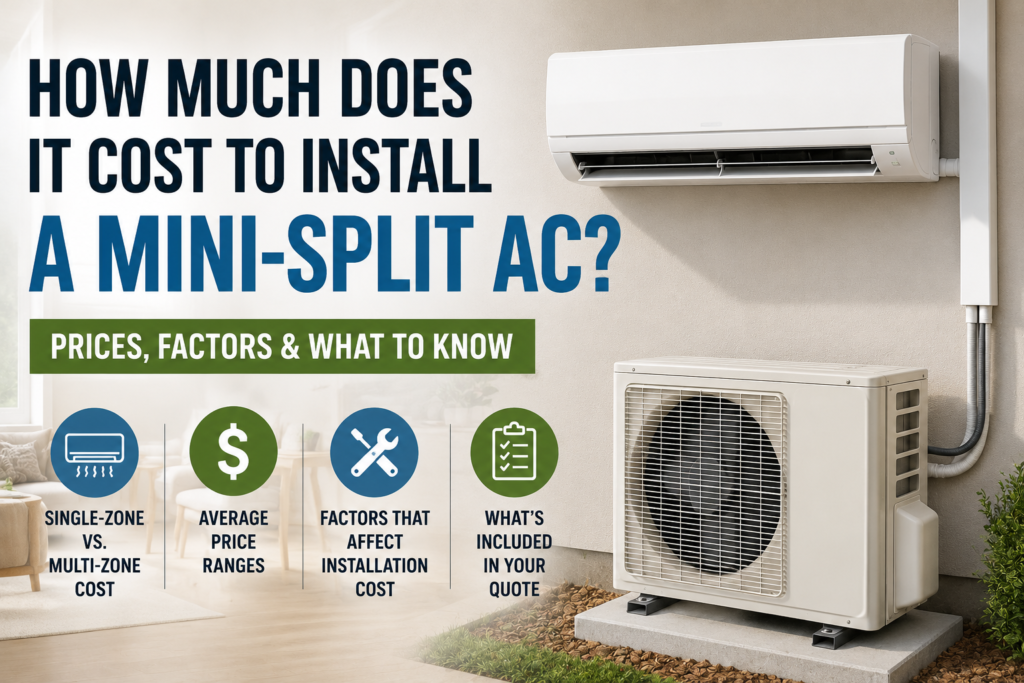
A professionally installed mini-split AC can cost anywhere from a few thousand dollars for a straightforward single-zone system to well over $10,000 for a multi-zone setup. As a broad national planning range, many installations fall somewhere between about $2,000 and $15,000+.
The number of zones usually has a major effect on the final price. Installing one indoor unit in a garage is a very different project from installing several indoor units throughout a home.
Equipment size, efficiency, electrical work, line-set length, drain routing, mounting location, permits, and access can all change the quote.
Those numbers are useful for budgeting, but they are not our current prices. We need to look at the rooms you want to condition and the installation itself before giving you a firm estimate.
Mini-Split Installation Cost at a Glance
Here are broad national planning ranges you may see while researching ductless HVAC:
| Type of project | Broad planning range | Common application |
| Single-zone mini-split | About 2,000–6,000 | One room or defined area |
| Multi-zone mini-split | About 5,000–18,000 | Several rooms or zones |
| Larger whole-home ductless system | Can exceed $10,000 | Multiple areas of a home |
| Installation labor alone | Roughly 1,000–3,500 in some national data | Labor before full equipment cost |
These figures cover a wide range of equipment and installation conditions.
If you are comparing them with a quote from us or another contractor, check how many indoor units are included and what installation work the proposal covers.
Pricing Disclaimer
Pricing Disclaimer: The prices and cost ranges in this article are provided for general informational and budgeting purposes only. They are based on national industry data and third-party sources and do not represent quotes, guarantees, advertised prices, or binding estimates from Brown Road Heating & Cooling. Actual HVAC costs can vary based on equipment type, system size, efficiency, installation requirements, labor, materials, permits, electrical or ductwork needs, property conditions, product availability, and other project-specific factors. Pricing may also change over time. Contact us for an inspection and written estimate based on your home and the work being proposed. Any written estimate or agreement provided directly by Brown Road Heating & Cooling will control over pricing information shown in this article.
How Much Does It Cost to Install a Single-Zone Mini-Split?
A single-zone mini-split often costs around $2,000 to $6,000 installed as a broad national planning range.
A single-zone system usually has:
- One outdoor unit
- One indoor air handler
- One refrigerant-line connection
- One condensate-drain route
- Controls for that zone
We commonly look at single-zone ductless systems for spaces such as:
- Bonus rooms
- Garages
- Workshops
- Home offices
- Sunrooms
- Guest suites
- Additions
- Finished rooms that existing ductwork does not serve well
One indoor unit does not mean every installation will cost the same.
A wall-mounted unit on an exterior wall near the outdoor equipment can be relatively straightforward.
An indoor unit on the second floor, farther from the outdoor condenser, may require a longer refrigerant run and more involved routing.
Electrical work can change the price too.
Before we recommend a mini-split for one room, we want to understand why that room is uncomfortable and how it is built.
If you are considering ductless for a problem room, check out our ductless mini-split installation services in Hendersonville for more information about the spaces we commonly work with.
How Much Does a Multi-Zone Mini-Split Cost?
A multi-zone mini-split system can cost roughly $5,000 to $18,000 or more depending on the number of zones, equipment, and installation.
The jump from a single-zone system is not simply the price of adding another wall-mounted head.
Each additional zone can involve:
- Another indoor air handler
- Refrigerant piping
- Control wiring
- Condensate drainage
- Mounting hardware
- Additional labor
- More outdoor-system capacity
- More planning for placement and airflow
A two-zone system may serve two rooms with very different comfort needs.
A three- or four-zone system can start to resemble a larger whole-home HVAC project.
| Number of zones | General cost tendency |
| 1 zone | Lowest |
| 2 zones | Higher |
| 3 zones | Higher again |
| 4+ zones | Can become a substantial project |
We do not recommend assuming that every room needs its own indoor unit before we see the property.
An open living area may function well as one zone. Several closed bedrooms are a different situation.
The layout matters just as much as the room count.
What Is Included in Mini-Split Installation Cost?
A mini-split quote should tell you more than the price of the equipment.
A professional installation may include:
- Outdoor mini-split condenser or heat pump
- Indoor air handler or handlers
- Mounting brackets or wall plates
- Refrigerant line set
- Protective line covering
- Condensate drainage
- Control wiring
- Electrical connections
- Wall penetration
- Outdoor equipment pad or bracket
- Refrigerant
- Installation labor
- Startup
- System testing
- Permit costs when applicable
- Removal of existing equipment when included
The exact scope matters.
Two contractors can both quote $4,500 and still be pricing different projects.
One proposal may assume the home’s electrical service is already ready for the new equipment.
Another may include a new circuit, disconnect, longer refrigerant run, line-hide, and additional drain work.
Before comparing totals, compare what each number buys.
How Much of Mini-Split Installation Cost Is Labor?
Labor can account for a meaningful portion of a mini-split installation.
National cost guides sometimes place labor alone around $1,000 to $3,500, though the amount depends heavily on the job.
The installer may need to:
- Measure the room
- Select indoor-unit placement
- Plan the outdoor-unit location
- Drill through an exterior wall
- Mount indoor equipment
- Install refrigerant lines
- Route drainage
- Install or coordinate electrical connections
- Pressure-test the refrigeration circuit
- Evacuate the system
- Start the equipment
- Confirm proper operation
A mini-split may look simple once it is hanging on the wall.
Getting there can require quite a bit of work.
The amount of labor also changes when we are installing more than one indoor unit or working around difficult access.
What Makes Mini-Split Installation Cost More?
Several parts of the project can move the final price.
Number of zones
This is one of the biggest variables.
One room needs one indoor unit in many installations.
Several rooms may require several indoor units and a larger outdoor system.
That means more equipment, more refrigerant lines, more drains, and more labor.
BTU capacity
Mini-splits come in different capacities.
A smaller room may need less heating and cooling capacity than a large open living area.
Higher-capacity equipment often costs more.
We do not size a system from square footage alone, though. Windows, insulation, ceiling height, sun exposure, and room use can all affect the load.
Equipment efficiency
Higher-efficiency mini-splits usually cost more upfront.
You may see efficiency ratings such as SEER2 when comparing equipment.
A higher rating can reduce electricity use for a given amount of cooling under standard test conditions, but we would not recommend buying equipment based on that number alone.
The system still needs to fit the room and your goals.
Indoor-unit style
Wall-mounted indoor units are common.
Other options can include:
- Ceiling cassettes
- Floor-mounted units
- Concealed ducted units
The equipment and installation method can change with each style.
Refrigerant-line length
The farther the indoor and outdoor units are from each other, the more material and labor the installation may require.
Routing lines around finished parts of a home can also make the job more involved.
Electrical work
Mini-split systems need electrical power.
Depending on the equipment and existing home setup, the project may require:
- Dedicated circuit
- Breaker
- Disconnect
- New wiring
- Electrical-panel work
We have to look at what is already there before we know how much electrical work is needed.
Indoor-unit placement
Placement affects both comfort and installation.
We look for a location that can distribute air through the room while still allowing future service access.
Mounting a head where furniture or walls block airflow can leave part of the room uncomfortable.
Outdoor-unit placement
The condenser needs proper clearance and a stable mounting location.
It also needs to be accessible for future maintenance.
A difficult second-story or tight-side-yard installation may involve more work than an open ground-level location.
Permits
Permit requirements depend on the project and local rules.
Ask whether permit costs are included in your quote.
Equipment removal
If we are replacing an existing mini-split, the old equipment may need to be removed and disposed of.
That can add labor to the project.
How Much Does a Mini-Split Cost by BTU Size?
BTU capacity affects the equipment price, but the size of the room alone does not tell us exactly what equipment you need.
You may commonly see sizes such as:
| Nominal capacity | Example type of space |
| 9,000 BTU | Smaller room |
| 12,000 BTU | Bedroom, office, or moderate room |
| 18,000 BTU | Larger room or open area |
| 24,000 BTU+ | Larger spaces or higher heating/cooling loads |
We look at several details when sizing ductless equipment:
- Room dimensions
- Ceiling height
- Insulation
- Windows
- Window direction
- Sun exposure
- Air leakage
- Number of exterior walls
- Occupancy
- Room use
- Local weather
- Existing HVAC
A sunny upstairs bonus room may need something very different from a shaded downstairs office of the same square footage.
Our mini-split installation process starts with the room and how you use it rather than choosing equipment from a square-foot chart.
Mini-Split Cost Per Room vs. Cost Per Zone
You will often see mini-split prices listed “per room” or “per zone.”
Those terms can sound interchangeable, but they are not always exactly the same thing.
A zone is the area controlled by one indoor unit or thermostat setting.
That might be:
- One bedroom
- One garage
- One large open kitchen/living area
- One finished attic
- One workshop
A single indoor unit may serve a larger open area well.
It may not distribute conditioned air evenly into several nearby bedrooms with closed doors.
That is why we look at the layout before deciding how many zones a house needs.
Some national pricing guides put installed costs around $2,000 to $7,000 per zone depending on the equipment and installation.
Treat that as a planning figure rather than a simple multiplication formula.
Adding a second zone may change the outdoor-unit size and equipment configuration, not just add the cost of one indoor head.
Does a Mini-Split Cost Less Than Central Air?
Sometimes.
The answer depends on what part of the house you are trying to condition.
A mini-split can make strong financial sense when you only need HVAC for one room and extending central ductwork would be difficult.
For example, installing ductless equipment in a finished garage may be simpler than rebuilding part of the existing central HVAC system to serve that space.
Whole-home comparisons are different.
| Situation | Mini-split may make sense when | Central HVAC may make sense when |
| One problem room | No usable ductwork reaches it | Existing ducts can serve it properly |
| Addition | Extending ducts would be difficult | Existing system has appropriate capacity |
| Older home | No ductwork exists | Suitable ducts are already installed |
| Whole home | Separate zoning is a major goal | Existing duct system is in good condition |
A multi-zone mini-split installation can become a substantial investment.
If you are comparing ductless with a conventional HVAC replacement, check out our HVAC installation and service options as well.
We can look at both approaches and help you understand which one fits the property better.
Mini-Split AC vs. Mini-Split Heat Pump Cost
Many residential mini-splits are heat pumps.
That means they provide both cooling and heating.
A cooling-only mini-split and a heat-pump mini-split are not necessarily the same product, so equipment prices should not be compared without checking what the system does.
A mini-split heat pump can cool the room during summer and reverse its refrigeration cycle to provide heat during colder weather.
That can make it useful for a space where you would otherwise need separate heating and cooling equipment.
If you want to learn more about heat-pump operation and service, visit our heat pump service page.
If you’re still getting familiar with ductless equipment, our guide to how a mini-split AC works explains the indoor unit, outdoor unit, refrigerant circuit, and zoning in more detail.
Are There Extra Costs Beyond the Mini-Split Quote?
There can be.
This is why we recommend asking what the proposal excludes as well as what it includes.
Possible additional expenses can include:
- Electrical-panel upgrade
- New circuit or breaker
- Longer-than-standard refrigerant lines
- Protective line-hide
- Condensate pump
- Difficult drain routing
- Wall repair
- Old equipment removal
- Permit costs
- Specialty mounting
- Additional controls
- Added indoor units
Suppose one quote assumes a standard line-set length and another room requires a much longer route.
That change may affect material and labor costs.
The same applies to electrical work. A home that already has the required capacity and wiring can be a different installation from one that needs electrical upgrades.
Ask about those conditions before approving the project.
Can You Install a Mini-Split Yourself to Save Money?
Some mini-split products are marketed for DIY installation.
A conventional professional installation can still involve work that goes beyond mounting an indoor unit.
That may include:
- Electrical connections
- Refrigerant piping
- Leak testing
- Vacuum and evacuation
- Condensate drainage
- Wall penetrations
- Outdoor-equipment mounting
- System setup
- Manufacturer installation requirements
Improper refrigerant, electrical, or drainage work can create performance and reliability problems.
Installation requirements can also affect manufacturer warranty coverage.
If you are considering a professionally installed system, ask what startup and testing are included in the quote.
We want the equipment to be correctly sized, mounted, connected, and tested before we consider the job complete.
Is a Mini-Split Worth the Installation Cost?
It can be when ductless equipment solves the right problem.
We often consider mini-splits for:
- Bonus rooms
- Garages
- Workshops
- Additions
- Sunrooms
- Home offices
- Guest suites
- Older homes without ducts
- Rooms that need separate temperature control
A mini-split may make less sense when the problem is somewhere else.
If poor insulation is causing the room to overheat, adding HVAC capacity does not fix the insulation.
If a damaged duct is starving a room of airflow, repairing the duct may make more sense.
If the entire central system is near the end of its service life, we may want to discuss the bigger HVAC picture rather than adding another system to one room.
We try to understand why the space is uncomfortable before recommending equipment.
You can learn more about the situations we commonly use ductless equipment for on our Hendersonville mini-split installation page.
How to Get an Accurate Mini-Split Installation Quote
We need more than the number of rooms before we can give you a useful estimate.
We may look at:
- Which rooms need heating and cooling
- Room dimensions
- Ceiling heights
- Insulation
- Windows
- Sun exposure
- Existing HVAC equipment
- Indoor-unit locations
- Outdoor-unit location
- Line-set routing
- Drainage
- Electrical service
- Number of zones
When comparing proposals, ask:
- How many indoor units are included?
- What BTU capacity is proposed?
- Is the equipment cooling-only or a heat pump?
- What efficiency rating does it have?
- Is electrical work included?
- Is the refrigerant line set included?
- How much line length is included?
- Are drain materials included?
- Are permits included?
- Is removal of existing equipment included?
- What controls are included?
- What manufacturer warranty applies?
- What labor warranty applies?
- Is system startup and testing included?
Those answers give you a better way to compare quotes than looking at the final number alone.
Frequently Asked Questions About Mini-Split Installation Cost
How much does it cost to install a mini-split AC?
A professionally installed mini-split can range from roughly $2,000 for some straightforward single-zone projects to $15,000 or more for larger multi-zone installations. Equipment size, number of zones, efficiency, electrical work, mounting, and installation complexity affect the final cost.
How much does a single-zone mini-split cost installed?
A single-zone mini-split commonly falls around $2,000 to $6,000 in broad national pricing data. The actual amount depends on equipment capacity, efficiency, electrical requirements, line-set distance, drainage, and installation access.
How much does a multi-zone mini-split cost?
Many multi-zone projects fall somewhere around $5,000 to $18,000 nationally. A two-zone system and a four-zone whole-home setup should not be expected to cost the same.
Why is mini-split installation expensive?
The price includes more than the indoor unit you see on the wall. A professional project can involve outdoor equipment, refrigerant piping, electrical work, drainage, mounting, pressure testing, evacuation, setup, and system testing.
How much does it cost to add another mini-split head?
There is no single price for adding another indoor unit. The cost depends on equipment compatibility, outdoor-system capacity, refrigerant-line routing, electrical controls, drainage, mounting location, and labor.
How much does mini-split installation labor cost?
Some national cost data places installation labor around $1,000 to $3,500. More complex or multi-zone projects can involve more work. We price labor based on the actual installation rather than assuming every mini-split takes the same amount of time.
Does mini-split installation require electrical work?
Often, yes. The system may need a dedicated circuit, breaker, disconnect, wiring, or other electrical work depending on the equipment and existing service.
Can one mini-split cool multiple rooms?
It depends on the layout. One indoor unit can work well for a large open zone, but it may not distribute air effectively into several closed rooms. We look at the floor plan before deciding how many zones are appropriate.
Does a mini-split provide heat too?
Many residential mini-splits are heat pumps and provide both heating and cooling. Cooling-only equipment also exists, so check the proposed model before comparing prices.
Do you install mini-splits?
Yes. We provide ductless mini-split installation for homeowners and small businesses in Hendersonville and nearby Western North Carolina communities.
Get a Mini-Split Installation Estimate
If you’re trying to budget for a mini-split, start with the space you want to condition rather than one price you found online.
We can look at the room, determine how many zones make sense, review indoor and outdoor equipment placement, and check the electrical and installation requirements before recommending a system.
Check out our mini-split installation services or call us at (828) 338-6261 to schedule an estimate in Hendersonville or a nearby Western North Carolina community.
Comments are closed