
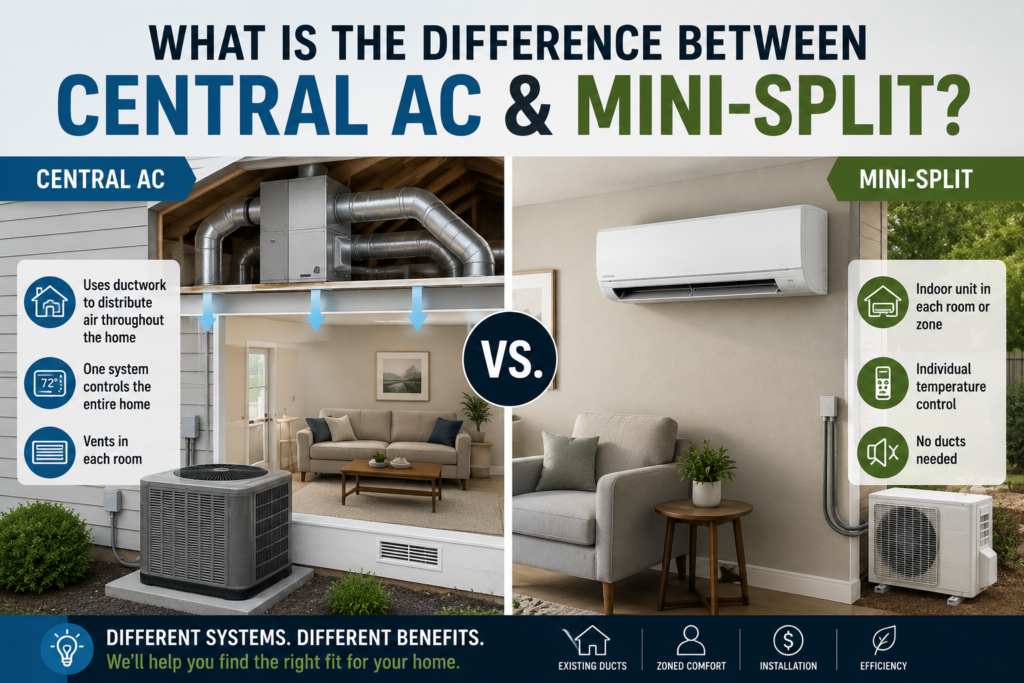
The biggest difference between central AC and a mini-split is how cooled air gets into the rooms. Central AC cools air at one indoor system and sends it through ductwork. A mini-split uses one or more indoor units that condition individual rooms or zones without relying on traditional ducts.
Both systems can cool a home well when they are properly sized and installed.
The better choice depends on the house you already have, the rooms you want to condition, whether usable ductwork is in place, and how much control you want from one room to another.
Central AC and Mini-Splits Solve the Same Problem in Different Ways
Central air and mini-splits both remove heat from indoor air.
They both rely on refrigeration equipment that typically includes:
- An outdoor compressor
- Refrigerant
- Indoor and outdoor coils
- Fans
- Temperature controls
The difference starts after the air is cooled.
A central AC system usually conditions air at one indoor coil. A blower then pushes that air through supply ducts to vents around the house.
A mini-split puts the indoor air handler much closer to the space it serves. That indoor unit draws air directly from the room, conditions it, and returns it to the same zone.
There is no large duct network between the indoor unit and the room.
If you want a deeper explanation of the equipment itself, check out our guide to how mini-split systems work.
For this comparison, the more useful question is how those two delivery methods affect your home.
The Biggest Difference Is How the Air Reaches You
Central AC relies on ductwork.
A typical setup includes:
- Return vents
- Return ducts
- Indoor coil
- Blower
- Supply ducts
- Supply registers
Air from the home returns to the HVAC system, passes over the indoor coil, and then moves through the supply side of the duct system.
One piece of equipment can serve many rooms this way.
A mini-split skips that distribution network.
The indoor unit is mounted in or near the zone it serves. It draws room air through its own filter and coil, then sends conditioned air directly back into the space.
The indoor and outdoor equipment are connected by refrigerant lines, electrical wiring, and drainage rather than large supply and return ducts.
That difference has several consequences.
Central AC can serve an entire home from a single system.
Mini-splits can give individual rooms more independence.
Neither approach is automatically better.
We start with the way the house is built and the comfort problem you are trying to solve.
One Thermostat or Room-by-Room Control?
A conventional central AC system often operates from one main thermostat.
If that thermostat is set to 72 degrees, the system works toward that target for the area the thermostat represents.
That can work very well when the home has:
- Properly sized equipment
- Balanced airflow
- Good ductwork
- Similar comfort needs throughout the house
It can become less convenient when different rooms need different temperatures.
A bedroom over a garage may heat up faster than a first-floor living room. A home office may be occupied all day while guest rooms sit empty.
Mini-splits handle those situations differently.
Each indoor unit usually controls its own zone.
That means one room can be set to a cooler temperature without changing the setting in another zone.
This room-by-room control is one reason homeowners consider ductless systems for:
- Bonus rooms
- Finished garages
- Additions
- Home offices
- Guest suites
- Workshops
Central HVAC can also be zoned in some homes with dampers, controls, and proper system design.
So the real comparison is not simply “central AC has one temperature and mini-splits have many.”
The question is how much zoning the home needs and which system makes sense for the layout.
Existing Ductwork Can Change the Entire Decision
One of the first things we look at is whether the home already has usable ductwork.
That can change the answer quickly.
If the house already has good ducts
Central AC may be the simpler path.
The air-distribution system is already there.
If the ducts are properly sized, sealed, and connected, a replacement central system can use that existing network to serve the home.
It also keeps most of the indoor HVAC equipment out of sight.
If the house does not have usable ducts
A mini-split can avoid the need for a much larger construction project.
Adding traditional ductwork may mean finding space in:
- Attics
- Crawl spaces
- Closets
- Chases
- Walls
- Ceilings
That can be difficult in older homes or finished spaces.
Mini-splits can make more sense when you want to condition a room or building area without rebuilding the property around a new duct system.
We commonly consider ductless equipment for additions, garages, bonus rooms, and older homes where extending the ductwork would be difficult.
You can read more about those applications on our ductless mini-split installation services page.
Which System Gives More Even Whole-House Comfort?
A properly designed central AC system can provide very consistent comfort across a house.
That depends on more than the air conditioner.
We also look at:
- Duct sizing
- Return-air placement
- Supply airflow
- Equipment capacity
- Insulation
- Air leakage
- Room orientation
If those pieces work together, central AC can cool many rooms from a single system without requiring visible indoor units in every space.
Mini-splits create comfort more locally.
That can be a major advantage when rooms have different schedules or different heating and cooling loads.
It can be less convenient when a home has many small, closed rooms.
One indoor unit in a hallway should not automatically be expected to cool several bedrooms behind closed doors.
A whole-home ductless design may require multiple indoor units.
That is why we do not treat “mini-split” as shorthand for “one unit cools the whole house.”
The layout matters.
Where Energy Can Be Lost With Each Setup
Energy use depends on the equipment, the house, and how the system is operated.
There is no universal rule that says every mini-split costs less to run than every central AC system.
Ductwork can be one source of loss in a central system.
Leaks, disconnected joints, or ducts running through hot attics can reduce the amount of conditioned air reaching the rooms.
A well-sealed and properly insulated duct system performs very differently from a neglected one.
Mini-splits avoid those traditional duct losses because the indoor unit delivers air directly into its zone.
They can also help you reduce conditioning in rooms that are not in use.
That can help in the right application.
Equipment efficiency still matters.
So do:
- Thermostat settings
- Insulation
- Air leakage
- Outdoor temperatures
- System sizing
- Number of zones
- Hours of operation
If you are comparing energy use, we would rather look at the actual house than tell you one system type always wins.
Installation Looks Very Different Between the Two Systems
Central AC and mini-splits can require very different installation work.
A central AC project may involve:
- Outdoor condenser
- Indoor coil
- Furnace or air-handler connection
- Existing ductwork
- Thermostat
- Refrigerant piping
- Drainage
- Electrical connections
A mini-split project may involve:
- Outdoor unit
- One or more indoor air handlers
- Wall or ceiling mounting
- Refrigerant line sets
- Drainage
- Control wiring
- Electrical circuit
- Wall penetrations
- Outdoor-unit mounting
A single mini-split serving one room can be a contained project.
A multi-zone system serving several rooms can involve much more equipment and labor.
If installation cost is a major factor in your decision, check out our guide to mini-split installation costs.
The Price Comparison Depends on How Much of the House You’re Cooling
Comparing central AC and ductless pricing only makes sense when the project scope is similar.
One difficult room
Suppose the central system keeps most of the house comfortable, but a finished garage has no ductwork.
Adding one mini-split may be more practical than rebuilding the central system around that one room.
Several rooms
Mini-split cost rises as more indoor units are added.
Each zone can require:
- Indoor equipment
- Refrigerant lines
- Drainage
- Controls
- Installation labor
Whole house with good ducts
If the home already has a working duct system, replacing central AC may be more straightforward than installing several mini-split zones.
That does not make central air cheaper in every house.
It means you need to compare the same amount of conditioned space and the same installation scope.
For central-system pricing, check out our guide to central air repair and replacement costs.
What You See Inside the Room Is Different Too
Appearance matters to some homeowners.
With central AC, most of the equipment is hidden.
Inside the living space, you generally see:
- Supply vents
- Return grilles
- Thermostat
The main indoor equipment is usually in an attic, crawl space, basement, utility room, or closet.
A mini-split puts an air handler directly in the room.
Wall-mounted units are common.
Other configurations may include:
- Ceiling cassettes
- Floor-mounted units
- Concealed ducted indoor units
Some homeowners like the control that comes with visible room equipment.
Others prefer HVAC to stay out of sight.
We treat that as a design preference rather than a technical advantage.
How Filtration and Indoor Air Movement Compare
Central AC typically moves household air through a central filter before distributing that air through the ducts.
Depending on the system, a central setup may also be able to work with:
- Higher-capacity filters
- Humidity-control equipment
- Whole-home air-cleaning equipment
Mini-splits filter air at the individual indoor unit.
Each zone recirculates its own room air through the local filter.
That means a home with several mini-split heads also has several filters to keep up with.
Neither setup automatically means better indoor air quality.
Filter type, maintenance, airflow, humidity, source control, and the condition of the house all matter.
The main difference is centralized filtration versus filtration at individual indoor units.
A Mini-Split Doesn’t Have to Replace Your Central AC
This is one of the most useful points in the comparison.
You may not need to choose a single system for the entire property.
A home can use central AC for most rooms and a mini-split for one area that needs separate help.
For example:
- Central AC serves the main house.
- A mini-split serves a finished garage.
Or:
- Central AC handles the first and second floors.
- A mini-split serves a new addition.
Or:
- The main HVAC system works well.
- One upstairs bonus room has a very different cooling load.
In those situations, replacing the whole central system with ductless equipment may be unnecessary.
Adding more ductwork may be unnecessary, too.
We first try to understand which part of the house has the problem.
If 90% of the home is comfortable, we do not automatically treat it as a whole-house HVAC failure.
Three Homes, Three Different Answers
The examples below are hypothetical, but they show why the same comparison can lead to different recommendations.
Home A: The ducts already work well
A 2,000-square-foot home has central air.
The ductwork serves the rooms evenly, airflow is good, and the homeowner likes having one thermostat.
The AC is simply nearing the end of its service life.
In that situation, we would probably start by looking at central replacement options.
Converting the whole property to several indoor mini-split units would add a new distribution approach without an obvious problem to solve.
Home B: The garage became an office
The main house is comfortable with central AC.
The homeowner finishes the garage and starts working there every weekday.
No usable ductwork reaches the room.
A single-zone mini-split deserves consideration.
It can give the new office its own heating and cooling without changing the HVAC system for the rest of the house.
Home C: An older house has no ducts
An older home uses a heating system that never required ductwork.
The homeowners want to add cooling to several rooms.
Installing a complete duct system would involve major changes to the property.
A properly designed multi-zone ductless system may be a strong option.
The house, rather than the equipment label, determines the direction of the conversation.
Questions We Ask Before Recommending Either System
When someone asks us whether central air or a mini-split is better, we want to know more about the property first.
We may ask:
- Does the home already have ductwork?
- Is the ductwork in good condition?
- Are you cooling one room or the whole house?
- Which rooms are uncomfortable?
- Is the existing HVAC system still working well?
- Are there airflow problems?
- Has anyone looked at the insulation?
- Do different rooms need separate temperature settings?
- Where could indoor mini-split units be mounted?
- Where would outdoor equipment go?
- How important is hidden equipment to you?
- Does the system need to provide heating too?
- Is this a new addition or an existing room?
- What is your budget for the project?
Sometimes those questions make the answer obvious.
Other times we need to inspect the home before recommending anything.
A Quick Way to Choose Between Them
This table is a useful starting point:
| Situation | Option worth looking at first |
| Whole home already has good ducts | Central AC |
| One room has no ducts | Mini-split |
| Finished garage or addition | Mini-split |
| Older home was built without ducts | Mini-split or multi-zone ductless |
| Large home is already served well by ducts | Central AC |
| Different rooms need separate settings | Mini-split |
| You want indoor equipment mostly hidden | Central AC |
| One room stays hot despite central AC | Diagnose the cause first |
That last situation deserves emphasis.
A hot room does not automatically need another air conditioner.
The cause could be:
- Damaged ductwork
- Poor insulation
- Air leakage
- Weak airflow
- Window heat gain
- Improper system balance
We want to understand why the room is uncomfortable before adding another HVAC component.
Common Questions About Central AC and Mini-Splits
What’s the biggest difference between central AC and a mini-split?
Central AC uses ductwork to distribute cooled air from one central indoor system. A mini-split uses individual indoor air handlers to condition rooms or zones directly without traditional supply and return ducts.
Can a mini-split cool an entire house?
Yes, in some homes. Whole-home ductless cooling usually requires several properly sized indoor zones or multiple systems. The number of units depends on the floor plan, room loads, and equipment capacity.
Is central AC cheaper than a mini-split?
It depends on the project. Central AC may make more financial sense when good ductwork is already in place. A single mini-split may be less involved when one room needs cooling and has no practical duct connection.
Which one uses less electricity?
Either system can be efficient. Mini-splits avoid traditional duct losses and allow zone control. Central AC can also operate efficiently when the equipment and ducts are in good condition. Actual electricity use depends on system efficiency, sizing, weather, insulation, settings, and household use.
Does a mini-split need an outdoor unit?
Yes. A typical mini-split uses an outdoor unit connected to one or more indoor air handlers.
Does central AC require ductwork?
Traditional central forced-air AC uses ducts to distribute conditioned air through the home.
Can central AC and a mini-split operate in the same home?
Yes. We often consider that setup when central HVAC serves most of the property well but one room, addition, garage, or other area needs separate conditioning.
Can mini-splits provide heat?
Many residential mini-splits are heat pumps, so they can provide heating and cooling.
Which system is better for an addition?
A mini-split is often worth considering when extending existing ducts would be difficult or when the central system was not designed for the added space. We still review the existing HVAC system and the addition’s heating and cooling loads before deciding.
Which option should I choose?
Start with the house. We look at existing ducts, room layout, comfort issues, equipment condition, zoning needs, and installation options before recommending central AC or ductless equipment.
Trying to Decide Between Central AC and a Mini-Split?
We do not start with the assumption that one system is better.
We start with the way your home is built and the problem you want to solve.
If your existing ducts already serve the house well, central air may make the most sense.
If you have a bonus room, garage, addition, older home, or another area without usable ductwork, ductless may be worth a closer look.
We work with central air, heat pumps, and mini-split systems throughout Hendersonville and nearby communities in Western North Carolina.
Check out our HVAC services or our ductless mini-split installation services, or call us at (828) 338-6261 to schedule an evaluation.
Comments are closed