
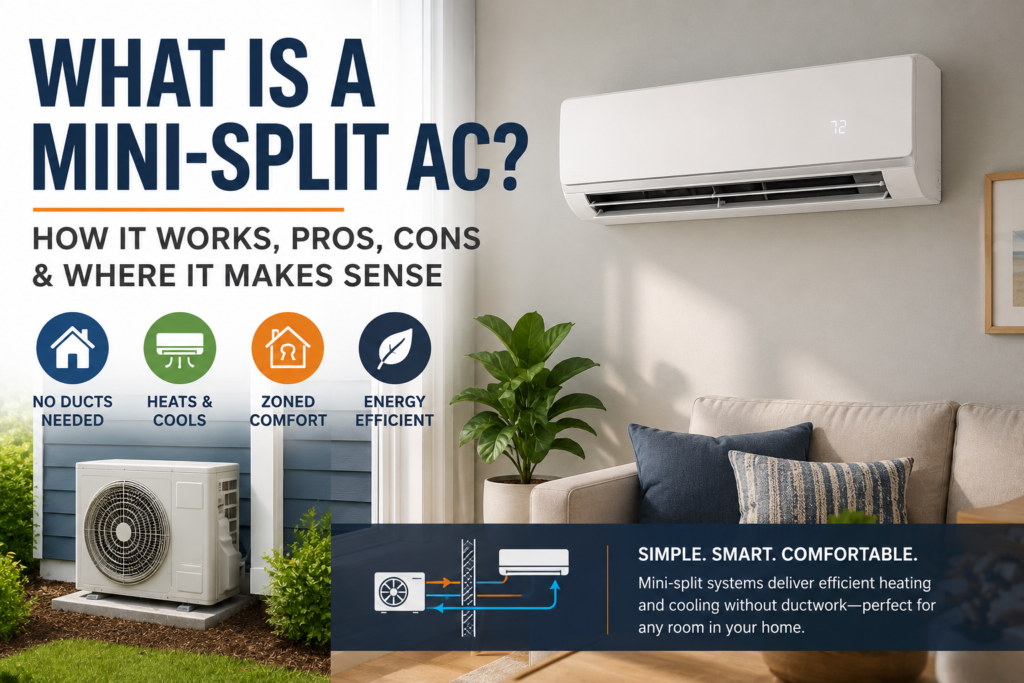
A mini-split AC is a heating and cooling system that serves a room or section of a home without relying on traditional ductwork. The system usually has an outdoor unit connected to one or more indoor units by refrigerant lines, electrical wiring, and a condensate drain.
Many mini-splits are heat pumps, meaning the same equipment can cool a room in warm weather and provide heat when temperatures drop. Instead of sending conditioned air from a central air handler through vents throughout the house, a mini-split delivers it closer to where you need it.
That setup can make sense for a bonus room that never cools properly, a finished garage, an addition, an older home without ducts, or another space that needs its own temperature control.
It does not make a mini-split the automatic answer to every hot or cold room. The condition of the existing HVAC system, insulation, room layout, electrical service, and actual heating and cooling load all matter.
Mini-Split AC at a Glance
| Question | Answer |
| Does a mini-split need traditional ductwork? | No |
| Does it have an outdoor unit? | Yes |
| Can it cool one room? | Yes |
| Can it serve several rooms? | Some multi-zone systems can |
| Can it provide heat? | Many mini-split heat pumps can |
| Can different rooms have separate settings? | Often, with a properly designed multi-zone setup |
| Where are mini-splits commonly used? | Additions, garages, bonus rooms, offices, older homes, and problem rooms |
| Does it need maintenance? | Yes |
| Should it be professionally installed? | Professional sizing and installation are recommended |
What Are the Parts of a Mini-Split System?
A mini-split looks simpler than a central HVAC system because there are no large ducts running through the home. There is still a complete refrigeration system working behind the scenes.
Indoor air handler
The indoor unit is the part you see in the room. Wall-mounted units are common, though floor-mounted units, ceiling cassettes, and other configurations are available.
The indoor unit contains a coil, fan, filter, and controls. Room air enters the unit, passes across the coil, and returns to the room after heat has been removed or added.
One reason placement matters is that the indoor unit needs a clear path to move air across the occupied space. A poorly positioned unit may leave one side of the room comfortable while another area struggles.
Outdoor unit
The outdoor equipment contains the compressor, coil, fan, and other refrigeration components.
During cooling, this is where the heat removed from the room eventually gets released outdoors. During heating on a heat-pump mini-split, the process changes direction.
Refrigerant lines
Small refrigerant lines connect the indoor and outdoor components.
Refrigerant circulates through those lines, changing pressure and temperature as it travels through the system. That process allows the equipment to collect heat in one location and release it somewhere else.
Condensate drain
Cooling air also removes moisture.
Water that forms on the indoor coil has to leave the unit through a drain. A clogged, damaged, or poorly installed drain can cause water to leak around the indoor unit.
Electrical connections and controls
The system needs electrical power for the compressor, fans, controls, and other components.
Depending on the equipment, homeowners may control the indoor unit with a handheld remote, wall control, thermostat, or compatible app.
How Does a Mini-Split AC Work?
A mini-split AC works by moving heat between the room and the outdoors.
During cooling, the indoor unit collects heat from the room. Refrigerant carries that heat outside, where the outdoor unit releases it. The indoor fan then circulates cooled air directly back into the room.
The basic process looks like this:
1. Room air moves through the indoor unit
The fan pulls air from the room across the indoor coil.
The goal is not to draw outside air into the room. A standard ductless mini-split mainly recirculates and conditions the air already inside the space.
2. The refrigerant absorbs heat
As the refrigerant passes through the indoor coil, it absorbs heat from the room air.
The air leaving the unit is cooler because some of its heat has been absorbed by the refrigerant.
3. The refrigerant carries the heat outside
The refrigerant travels to the outdoor unit.
The compressor changes the refrigerant’s pressure so the system can release the heat it collects through the outdoor coil.
4. The cycle repeats
After releasing heat outdoors, the refrigerant returns to the indoor side of the system, and the process continues until the room reaches its set temperature.
This is based on the same general refrigeration principle used by conventional split-system air conditioners. The major difference is air distribution. Central AC typically conditions air in a single indoor unit and distributes it through ducts. A ductless mini-split places the indoor unit in the room or zone it serves.
How does a mini-split provide heat?
A heat-pump mini-split can reverse the process.
During colder weather, the system collects heat from outdoor air and moves it indoors. There can still be usable heat energy in the outside air even when the day feels cold.
The U.S. Department of Energy describes heat pumps as equipment that transfers heat rather than generating it directly. During summer, heat moves from the home to the outdoors. During heating, heat flows in the opposite direction.
Why Is It Called a Mini-Split?
The name makes more sense once you look at the equipment.
Split refers to the arrangement in which major system components are divided between an indoor unit and an outdoor unit.
A conventional central air conditioner can also be a split system. The difference is that central equipment usually relies on ductwork to distribute air through a larger portion of the home.
Mini generally refers to the system’s smaller, zone-focused nature.
You may hear several terms used for similar equipment:
- Mini-split
- Ductless mini-split
- Ductless AC
- Mini-split heat pump
- Ductless heat pump
They do not always describe identical equipment. Some systems are cooling-only. Many residential mini-splits sold today are heat pumps that can provide heating and cooling.
Single-Zone vs. Multi-Zone Mini-Splits
One of the first decisions in a mini-split project is how many spaces need their own indoor units.
| Type | Typical setup | Common application |
| Single-zone | One indoor unit connected to one outdoor unit | One room or a defined area |
| Multi-zone | Several indoor units are connected to compatible outdoor equipment | Several rooms or zones |
Single-zone mini-split
A single-zone system serves one room or area.
This can work well when the comfort problem is isolated.
Common examples include:
- Bonus room
- Garage
- Workshop
- Home office
- Sunroom
- Guest suite
- Finished attic
- Addition
The room can have its own temperature setting without changing the thermostat for the rest of the house.
Brown Road Heating & Cooling already uses ductless systems in many of these types of spaces around Hendersonville.
Multi-zone mini-split
A multi-zone system connects more than one indoor unit to compatible outdoor equipment.
Each indoor unit typically serves its own area, allowing temperature to be adjusted by zone.
This can be useful in an older home with several rooms and no practical duct system, a multi-room addition, or a property where different spaces are occupied at different times.
Multi-zone design takes more planning. The outdoor equipment needs enough capacity for the connected zones, and each room still needs to be evaluated on its own.
A three-bedroom floor plan, for example, should not be treated as three identical loads simply because the rooms are similar in size. Windows, sun exposure, insulation, ceiling height, and room use can change what each zone needs.
Are Mini-Split AC Units Good?
Mini-split AC units can be a good choice when the problem is limited to a room or area that lacks suitable ductwork or requires separate temperature control.
They are particularly useful when installing new ducts would require major changes to finished walls, ceilings, floors, or attic spaces.
They can also make sense when the homeowner regularly uses only part of the property and wants separate control over that space.
A mini-split may make less sense when the entire central HVAC system is struggling, when existing ductwork can properly serve the area, or when insulation and air leakage are the real reasons a room feels uncomfortable.
Brown Road’s current mini-split guidance takes the same project-by-project view. We usually suggest that ductless may suit a single area, while central HVAC work may be more appropriate when the entire home is uncomfortable.
Advantages of Mini-Split AC Systems
They do not need traditional ductwork
This is one of the main reasons homeowners consider mini-splits.
Adding full-size ducts to an older home or a finished addition may require opening walls or ceilings and making room for large air passages. A mini-split needs connections between the indoor and outdoor units, though it does not require a traditional whole-house duct system.
Each zone can have its own setting
A mini-split can give one room a temperature setting that is separate from the main house.
That can be useful when an office is occupied all day but a guest room is rarely used, or when a finished room over a garage behaves differently from the rooms below it.
Duct losses are removed from the equation
Duct systems can lose conditioned air through leaks and poorly connected sections.
ENERGY STAR says duct losses can account for more than 30% of a home’s space-conditioning energy use in some situations. A ductless mini-split avoids that particular source of loss because the indoor unit sends conditioned air directly into the room.
That does not mean every mini-split automatically lowers a homeowner’s power bill. Equipment efficiency, sizing, thermostat habits, insulation, climate, and the system being replaced still matter.
Many models provide heating and cooling
A heat-pump mini-split can serve as both an air conditioner and a heating system.
This can reduce the need for separate window AC units and portable electric heaters in a room that is regularly used.
They can fit spaces that central ducts do not reach well
Older homes, additions, converted garages, workshops, and other finished spaces may have little or no room for additional ductwork.
ENERGY STAR identifies older homes without ducts, additions, outbuildings, and rooms above garages as common applications for ductless heat pumps.
Indoor equipment tends to be quieter than a window unit
The compressor is located outside rather than sitting in a window opening.
There is still fan noise from the indoor unit, and sound levels vary by model and operating speed.
What Are the Downsides of Mini-Splits?
Mini-splits solve some problems well. They also come with tradeoffs.
The indoor unit is visible
A wall-mounted air handler becomes part of the room.
Some homeowners do not mind the appearance. Others would rather have heating and cooling delivered through vents with the main equipment out of sight.
Ceiling and floor configurations may offer alternatives depending on the room and equipment.
Each zone adds equipment
Conditioning one difficult room may be straightforward.
Serving many enclosed rooms can require several indoor units, additional refrigerant lines, additional drains, and more installation planning.
At some point, another HVAC design may make more sense.
Filters still need attention
Ductless does not mean maintenance-free.
Indoor filters collect dust. Coils can become dirty. Condensate drains can clog. Outdoor equipment needs clear airflow. Electrical and refrigerant components still need to operate correctly.
Brown Road recommends maintenance that can include filter cleaning, indoor and outdoor unit checks, drainage review, and performance testing.
Placement can affect comfort
An indoor unit needs room to throw air across the space.
Putting it behind a tall cabinet, near an obstruction, or in a poor location for the room’s layout can reduce how evenly the space feels conditioned.
Service access needs to be considered, too.
It does not fix building problems
Suppose a bonus room is uncomfortable because the roof assembly has poor insulation and significant air leakage.
Installing more heating and cooling capacity may change the room temperature. It does not repair the building envelope.
The cause of the comfort problem should be identified before selecting equipment.
Standard ductless units are not whole-home ventilation systems
A typical wall-mounted mini-split conditions the air within the room.
Homeowners who need controlled fresh-air ventilation may need separate equipment or a different HVAC design.
Where Do Mini-Splits Work Best?
Mini-splits are most useful when there is a clearly defined room or zone that needs heating and cooling.
Bonus rooms
Rooms over garages are common trouble spots.
The space may have more exposure to outdoor temperatures than the rest of the home, and the original duct system may not have been designed to serve it well.
A mini-split can give that room its own equipment and thermostat settings.
Additions
An addition changes the home’s heating and cooling load.
Extending existing ducts is one option, but the current system may not have been sized for the extra space. A separate mini-split can sometimes serve the addition without changing the rest of the central HVAC layout.
Garages and workshops
A finished garage, hobby space, or workshop may never have had ductwork.
A mini-split can provide a permanent heating and cooling option when the room is suitable for conditioning.
Insulation still matters. Trying to heat or cool a poorly sealed garage can waste energy, regardless of the type of equipment.
Sunrooms
Glass area and sun exposure can make sunrooms behave differently from the rest of the house.
A mini-split can give the room independent control, though sizing should account for those large windows and changing solar loads.
Older homes without ducts
Some homes were built around boilers, radiators, baseboard heating, or other systems that never needed large air ducts.
Adding ducts later can be disruptive.
Ductless equipment can provide cooling and, with a heat-pump system, heating without having to rebuild the home around a conventional forced-air system.
Home offices and guest rooms
Rooms used on different schedules from the main house can benefit from separate control.
A home office may need cooling throughout the workday, while other rooms remain mostly empty.
Rooms that stay hotter or colder than the rest of the house
A mini-split may solve that problem.
The reason for the temperature difference should be checked first.
A damaged duct, a closed damper, weak airflow, an insulation problem, or an improperly balanced central system may have a simpler fix.
When Might a Mini-Split Be the Wrong Choice?
A mini-split may be worth skipping when the project starts with the wrong problem.
If every room in the home is uncomfortable, the central HVAC system warrants attention before adding another piece of equipment.
If an existing duct run is crushed or disconnected, repairing the duct may make more sense than installing a separate mini-split.
If a room has large air leaks or poor insulation, addressing those conditions may reduce the heating and cooling problem.
A ductless system may also be less appealing when the homeowner strongly prefers hidden equipment or when serving many small rooms would require a complicated collection of indoor units.
Brown Road approaches these projects by assessing the room, existing HVAC equipment, placement options, and the reasons the space is uncomfortable before recommending a system.
Mini-Split vs. Central Air
Mini-splits and central air conditioners both move heat out of a home during cooling. They differ most in how the conditioned air reaches the living space.
| Feature | Mini-split | Central air |
| Traditional ductwork | Usually not required | Usually required |
| Temperature control | Room or zone based | Commonly centralized |
| Indoor unit visibility | Often visible | Main equipment usually hidden |
| Good application | Specific zones or homes without ducts | Whole homes with suitable ducts |
| Air distribution | Directly from indoor unit | Through supply ducts |
| Heating capability | Many are heat pumps | Depends on paired equipment |
Central air can be a good fit when the house already has properly designed ductwork and the goal is to condition most or all of the home with a single system.
Ductless can be useful when the project centers on a single difficult room, an addition, or a building where installing ducts would be challenging.
Neither system wins every comparison.
The better option is the one that fits the building and the problem being solved.
Mini-Split vs. Window AC
A window air conditioner and a mini-split can both cool a single room.
The experience is different.
A window unit occupies part of the window opening, places the compressor close to the living space, and is often purchased as an appliance rather than designed into the home’s HVAC system.
A mini-split places the compressor outside, leaving the window available. Heat-pump versions can also provide heating.
The tradeoff is installation. A mini-split is a permanent HVAC system that requires equipment selection, electrical work, refrigerant connections, drainage, and proper placement.
For a room that is cooled only a handful of days each year, a window unit may be enough.
For a finished space used year-round, a mini-split may deserve a closer look.
Do Mini-Splits Save Energy?
Mini-splits can use less energy when properly applied.
Removing duct losses is one reason. Zoned operation is another. Many systems also use variable-capacity compressors that adjust output rather than operating only at full capacity.
Heat-pump models move heat rather than produce it using electric resistance elements. DOE notes that this heat-transfer process is why heat pumps can provide efficient heating and cooling.
Actual household savings depend on what the mini-split replaces.
Replacing an old electric baseboard heater and inefficient window AC is a different comparison from adding a mini-split to a home that already has a newer high-efficiency central heat pump.
Energy use is also affected by:
- System size
- Outdoor temperatures
- Building insulation
- Air leakage
- Number of zones
- Thermostat settings
- Equipment efficiency
- How often each room is occupied
ENERGY STAR notes that variable-speed compressors and direct delivery of conditioned air are two reasons certified mini-split heat pumps can reduce energy use in suitable homes.
Do Mini-Splits Need Maintenance?
Yes.
A mini-split has many of the same basic needs as other cooling equipment.
Homeowners should pay attention to the indoor filter and keep the area around the outdoor unit clear.
Professional maintenance may include checking:
- Indoor filters
- Indoor coil condition
- Outdoor coil
- Condensate drainage
- Electrical connections
- Refrigerant circuit
- Fan operation
- Controls
- Temperature performance
- Unusual noise or vibration
Call for service when the unit stops heating or cooling normally, develops weak airflow, leaks water, produces an unusual odor, stops responding to its control, or has an outdoor unit that does not run.
Brown Road provides mini-split service and repair for those types of problems in Hendersonville and nearby communities.
How Do You Know What Size Mini-Split You Need?
Mini-split sizing should start with the room rather than a simple square-foot rule.
Two 400-square-foot rooms can have very different heating and cooling loads.
One may be shaded, well-insulated, and located in the middle of the home. The other may sit over a garage with several large west-facing windows.
A contractor may consider:
- Room dimensions
- Ceiling height
- Insulation
- Window area
- Window orientation
- Sun exposure
- Exterior walls
- Air leakage
- Number of occupants
- Appliances and electronics
- Room use
- Local summer and winter conditions
Indoor unit placement also matters.
Brown Road’s current installation process considers room size, ceiling height, wall space, window placement, sun exposure, furniture layout, service access, and room use.
Buying a larger unit simply because it has more capacity can create its own comfort problems.
The goal is equipment that matches the space’s load.
Is a Mini-Split Right for Your Home?
A mini-split is worth discussing when you have a specific comfort problem and a clear reason conventional ductwork is not serving the space.
It may make sense if:
- You are finishing a garage or bonus room.
- You built an addition outside the original HVAC layout.
- One room needs separate temperature control.
- The home does not have central ductwork.
- Extending ducts would require major construction.
- You want to replace window units in a room used regularly.
- You have a workshop, office, or guest suite with different operating hours from the rest of the house.
Another option may deserve attention when the whole house has trouble maintaining temperature, the existing ducts need repair, or poor insulation is driving the comfort problem.
Brown Road Heating & Cooling installs and services ductless mini-split systems in Hendersonville and nearby communities in Western North Carolina. A site visit can help determine whether the room needs ductless equipment, central HVAC work, or another correction.
Frequently Asked Questions About Mini-Split AC
What is a mini-split AC?
A mini-split AC is a heating and cooling system with an outdoor unit connected to one or more indoor air handlers. It can condition a room or zone without a traditional duct network. Many mini-splits are heat pumps that provide both cooling and heating.
How does a mini-split AC work?
During cooling, the indoor unit absorbs heat from the room air. Refrigerant carries that heat to the outdoor equipment, which releases it outside. The indoor fan sends cooled air directly back into the room. Heat-pump models can reverse this process to provide heating.
Are mini-split AC units good?
They can be a good fit for additions, garages, bonus rooms, older homes without ducts, and rooms that need separate temperature control. They may be a poor fit when a whole-house HVAC problem, damaged ductwork, or poor insulation is the real issue.
Can a mini-split heat and cool?
Many mini-splits are air-source heat pumps and can provide both heating and cooling. Cooling moves heat outdoors. Heating reverses the refrigeration cycle, moving heat from the outdoor air into the home.
Does a mini-split need ductwork?
A standard ductless mini-split does not need conventional whole-house ductwork. Refrigerant lines, electrical connections, and drainage still have to connect the indoor and outdoor equipment.
Can one mini-split cool multiple rooms?
A multi-zone system can connect several indoor units to compatible outdoor equipment. Each indoor unit typically serves its own room or zone. One wall-mounted unit should not automatically be expected to cool several closed rooms simply because they are nearby.
Do mini-splits bring fresh air into the house?
Standard ductless indoor units mainly recirculate and condition air already in the room. They should not be treated as a dedicated fresh-air ventilation system.
Are mini-splits good for older homes?
They can be particularly useful in older houses that were built without ductwork. The small refrigerant and electrical connections are often easier to accommodate than installing a large network of new ducts. ENERGY STAR lists older homes without existing ducts as a common application for ductless heat pumps.
Can a mini-split cool a whole house?
It can in some homes when the system is properly designed with enough indoor zones and outdoor capacity. Whole-house ductless design depends on room layout, heating and cooling loads, number of zones, and equipment selection.
Do mini-splits need professional installation?
Professional installation helps address load sizing, electrical requirements, refrigerant connections, drainage, indoor unit placement, outdoor clearances, and system startup. These details can affect comfort, efficiency, reliability, and future access to service.
Talk With Brown Road About Ductless Heating and Cooling
A mini-split can be a practical answer when one area of a home needs its own heating and cooling system. The deciding factor is the space itself.
Brown Road Heating & Cooling installs, repairs, and maintains ductless mini-splits for homeowners and small businesses in Hendersonville and nearby communities in Western North Carolina.
If you have a bonus room, garage, addition, office, older home, or another space that never stays comfortable, call (828) 338-6261 to schedule an evaluation and discuss whether a mini-split makes sense for the property.
Comments are closed